


What was Mercedes' killer advantage in Qatar GP qualifying?
Kimi Antonelli's bluster after missing pole created a smokescreen – concealed within it was an ominous message to Mercedes' rivals

Autosport Explains
Our experts decode the most important stories in motorsport.
Mercedes has taken a few races to properly reap the benefits of its final upgrade package of the year. But it did so commandingly in Qatar as George Russell and Kimi Antonelli qualified 0.128s apart, leaving their chief rivals half a second or so adrift.
The Lusail circuit offers Formula 1 team a conundrum in the form of one high-speed corner after another, combined with a smoothly polished asphalt grading. Fast corners ought to correlate to high temperatures, but the smoothness militates against the process of hysteresis, where some of the kinetic energy is converted into heat as the rubber contracts and expands and is pressed into the surface pores. Having to run the front tyres at the highest pressure of the season – 29psi – to protect their structural integrity adds to the difficulty level of building heat through the surface and into the carcass.
That reasoning formed part of Ferrari's excuse note for Charles Leclerc and Lewis Hamilton being over a second off pole. For McLaren and Red Bull the explanations were more subtle.
Although Red Bull's RB22s were strong through the second sector, the Mercedes pace blew them away through the third – ditto McLaren. Nobody could match the W17s through the fast right-right-right of Turns 12 to 14, a ridiculously quick section where you effectively have to commit and then just hang on – or not, as Pierre Gasly proved on Friday.
"Part of that is just pure downforce and it's also partly down to deployment," said Max Verstappen in his Dutch media session afterwards.
One theory, put forward by Leclerc, was that Russell and Antonelli were using more electrical deployment into Turn 12, then enjoying the benefits of prodigious downforce to consolidate that speed through the rest of the complex.
"I think if I go through those corners at the speed they're doing," mused Verstappen, "I'll be spinning off the track everywhere. Of course, we can set our deployment strategy up like that as well, but I don't think that's a good idea for us…"

Andrea Kimi Antonelli, Mercedes
Photo by: Rudy Carezzevoli / Getty Images
Where it really went wrong for Antonelli
After Antonelli won the championship in Mexico City, Mercedes team boss Toto Wolff was at pains to emphasise his young charge's 'Mr Nice' credentials, saying the era of the "selfish" and "ruthless" F1 driver was over. Well, Antonelli assuredly grew horns during Q3 in Qatar, making public his annoyance at a run plan which called for him to be first out of the pitlane rather than last for the final runs.
Both before and after that final push lap, Antonelli expressed his vexation in an unusually strident manner, bending race engineer Peter Bonnington's ear on his cool-down lap with a snappy, "Next time if I ask something, please do it." On the first time around, 'Bono', well accustomed to his driver chafing on the radio after years of working with Hamilton, deployed his best airline-pilot tones to suggest diplomatically that Antonelli just get on with the job; afterwards, in a message unbroadcast on the world feed, Wolff attempted to coax Antonelli down from the ceiling by saying "it's on us".
Wolff's explanation to the media afterwards was that Mercedes wanted Antonelli nearer the head of the queue to get out than the back, given the risk of arriving at the timing line for his push lap to find the chequered flag already fluttering.
Antonelli had been faster than Russell through practice, albeit by relatively small margins in FP2 and FP3. But he had been most comfortable on the mediums and admitted later to not liking the feel of the softs when pumped up to Pirelli's prescribed minimum of 29psi on the front axle. Russell was then quicker through qualifying, which must account for at least some of Antonelli's frustration – as well as him pinning his hopes on getting a track position in his final run which might benefit him in terms of a tow or track evolution.
After qualifying, Antonelli admitted where his shortfall was: "I feel like I've been struggling a lot in sector two. I was strong in sector one, sector three. But sector two has never been good enough in qualifying.
"I was struggling with locking in Turn 6. I couldn't really attack the brake – and then also Turn 10, just not finding the right balance between entry and exit."

Andrea Kimi Antonelli, Mercedes
Photo by: Colin McMaster / LAT Images via Getty Images
Indeed, his fastest laps in each segment of qualifying were off his team-mate by a small but significant amount through the second sector (by 0.145s, 0.290s and 0.145s). In Q2 that accounted for all but 0.004s of Antonelli's overall deficit, so you can see the attraction of looking for another means of overcoming what was a persistent shortfall.
Whether by accident or design, Russell kept his powder dry until qualifying. FP2 didn't necessarily give a clear picture of relative pace, having been disrupted by two red flags, and Russell admitted to holding back through FP3 so as not to damage his floor by taking liberties with the kerbs.
A look at the data and the onboards suggests Russell was attacking the entry of the corners less than he usually does, focusing on carrying a slightly higher minimum cornering speed and then really attacking the exits. It's a story of fine margins, and any marginal differences in electrical deployment are impossible to unpick in the data available to Autosport.
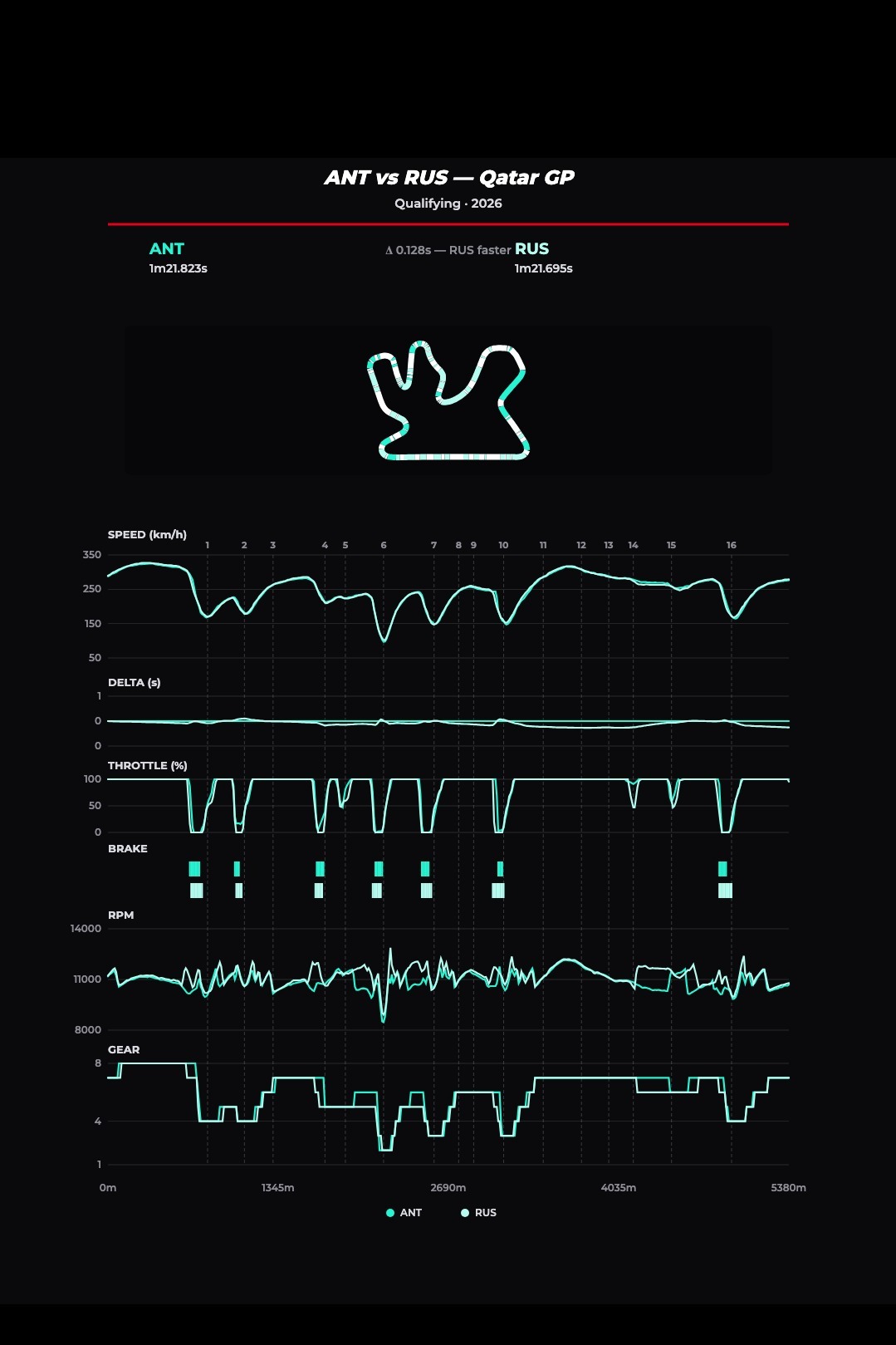
What you can see, backed up by comparison of the onboards, is that difference of approach: Antonelli committing harder to most entries, but then struggling to slow the car neatly into Turn 6, the slowest on the circuit. The overall margin there was in the noise of less than a tenth. What really made the difference was Turn 10, where Russell hugged the right-hand margin of the entry deeper and longer, compromising his entry speed but giving him a neater exit angle.
On our data trace that reveals itself as a very brief inversion of the delta before it swings in Russell's favour again: it's flat out from here until Turn 14, so a better exit speed is the gift that keeps on giving. Viewed from onboard, it was Russell who looked scruffier as the rear axle wriggled under duress, as if his rear tyres were giving up the ghost already, but he held on to it.
Smaller throttle lifts through Turns 14 and 15 then enabled Antonelli to come back before, again, Russell compromised his entry into the final corner so as to carry fractionally more apex speed and get back on the throttle earlier. They arrived at 100% at almost the same time but Russell's more decisive application opened the delta once again.
"I just had so much confidence in the car – something I've missed for a while – but I'm happy," said Russell.
Where rivals lost out
Q3's tightest battle was for third place, won by Lando Norris – 0.480s off Russell but 0.070s ahead of McLaren team-mate Oscar Piastri, who in turn was 0.046s quicker than Isack Hadjar's Red Bull. Hadjar, having bettered Verstappen by 0.041s, took this as a win and arrived in the media 'pen' afterwards with a broad grin hitherto unseen during his two seasons in F1.
Comparing the data between Russell and Norris renders Mercedes' superiority as starkly as the timings. The Malaysia update shifted the dials of the W17's performance characteristics, adding peak downforce at the expense of some truculence in slow corners. There is only one such turn in Qatar but by that point Norris was already down, and all he could do was occasionally staunch the losses. From Turn 7 onwards the delta was almost uniformly one-way traffic – away from Norris.
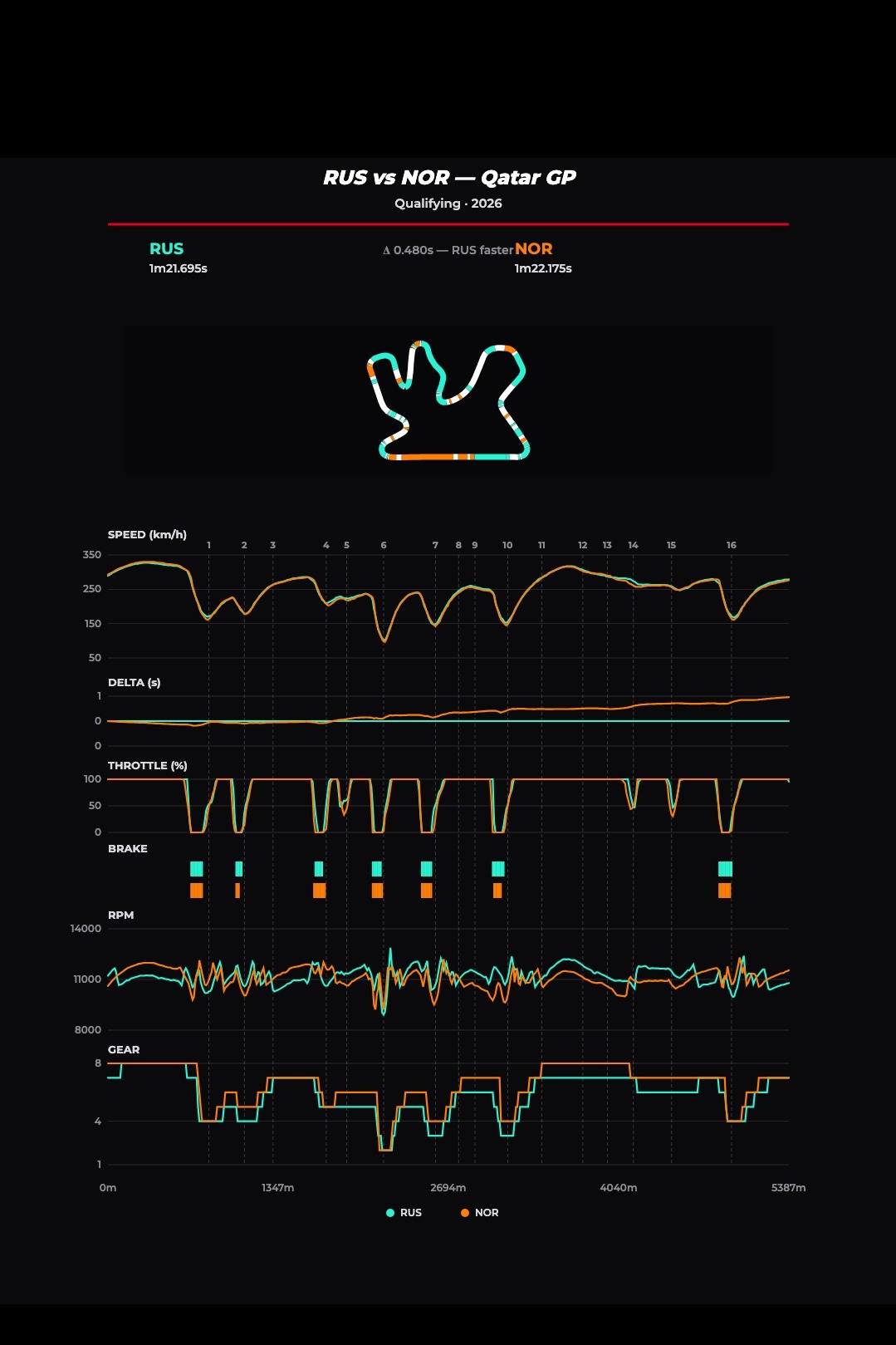
For all the medium and high-speed corners which predominate at Lusail, Russell could roll off the throttle later and get fully back on it earlier, which illustrates the greater confidence the W17's platform was giving him. Ditto the higher peak speed through Turns 12-14. The McLaren's tail-off towards the end of the lap suggests a deficiency in deployment optimisation, too.
"We've had, I guess, five or six races now with this package," said Russell. "We definitely didn't hit the ground running with it. Red Bull have been exceptionally competitive recently, but I think this circuit just hits all the right spots for our car."
McLaren team boss Andrea Stella went slightly further in that assessment, extrapolating Mercedes' performance in the context of the season to come.
"While we've seen some variability from a competitiveness point of view at the different circuits, layouts, and circuits demand that we have visited recently, I think this circuit sets a very clear premium to the car that has the best downforce in the medium and high speed," he said.
"I would say, if anything, that Mercedes sends a bit of a message to the entire paddock in terms of what downforce you can extract from these regulations. And this is a message we've all received."


How the Red Bull-Ford powertrain partnership has delivered so quickly

Hankook poised to enter race for F1 tyre supply contract

The two debates at the heart of F1’s overtaking quandary

F1 drivers go through quizzical exercise in stewarding debate

War of the words: What will Verstappen and Russell do for an encore?

Who was the biggest loser as Antonelli played draft excluder in Las Vegas?

Cadillac retaining Bottas for F1 2027 is the logical move

The factors behind the abortive 2030 F1 rules announcement

LIVE: F1 Qatar GP updates - Russell leads Antonelli and Piastri

MotoGP Valencia GP: Fernandez wins finale with Marquez second on farewell

Why Verstappen thinks Qatar GP reality check is actually positive for Red Bull

Live: Follow Marc Marquez's final MotoGP race in Valencia as it happens
Subscribe and access Autosport.com with your ad-blocker.
From Formula 1 to MotoGP we report straight from the paddock because we love our sport, just like you. In order to keep delivering our expert journalism, our website uses advertising. Still, we want to give you the opportunity to enjoy an ad-free and tracker-free website and to continue using your adblocker.


Top Comments