


F1 reports 35% CO2 reduction ahead of 2030 targets
Formula 1 says it has achieved around 12% of year-on-year CO2 reductions in 2025, as it remains on track for its 2030 targets


Photo by: Maya Dehlin Spach / LAT Images via Getty Images
Autosport Business
Covering industry news and insight into the business of motorsport
Formula 1 says it reduced its carbon emissions by 12% in 2025 and by 35% over the past eight years, keeping it on track to achieve a 50% reduction by 2030.
F1 set the goal of becoming "Net Zero" by 2030, which it claims would be delivered through a 50% reduction of its own emissions compared with 2018 levels. For the remaining unavoidable emissions that come with putting together a dense 24-race calendar, the championship will use what it calls an "offset using credible programme".
In its latest report, which was verified by carbon accounting company Normative, F1 operations both at the factories, around the race tracks and the extensive travel in between the two emitted 148,805 tco2e (tonnes of carbon dioxide equivalent), which is an 11.8% reduction compared to 2024's figure of 168,720.
Compared to the 228,793 tco2e baseline figure from 2018, F1 has reduced its emissions by 35% over the past eight years, keeping it on track to halve them over the next for years by 2030.
The biggest gains were found at the various factories and facilities operated by F1 management and its teams as they transitioned to renewable energy sources.
F1 has also been reducing its travel emissions by ramping up its investments in sustainable aviation fuel and more remote operations, reducing the amount of freight shipped to every race. More and more teams have also switched to sustainable fuel in their trucks, while F1 started investing in sustainable maritime fuel for its sea freight.
Following trials at the 2023 Austrian Grand Prix, F1 has now rolled out renewable energy at all European races for its paddock operations, using a combination of solar and HVO (hydrotreated vegetable oil).
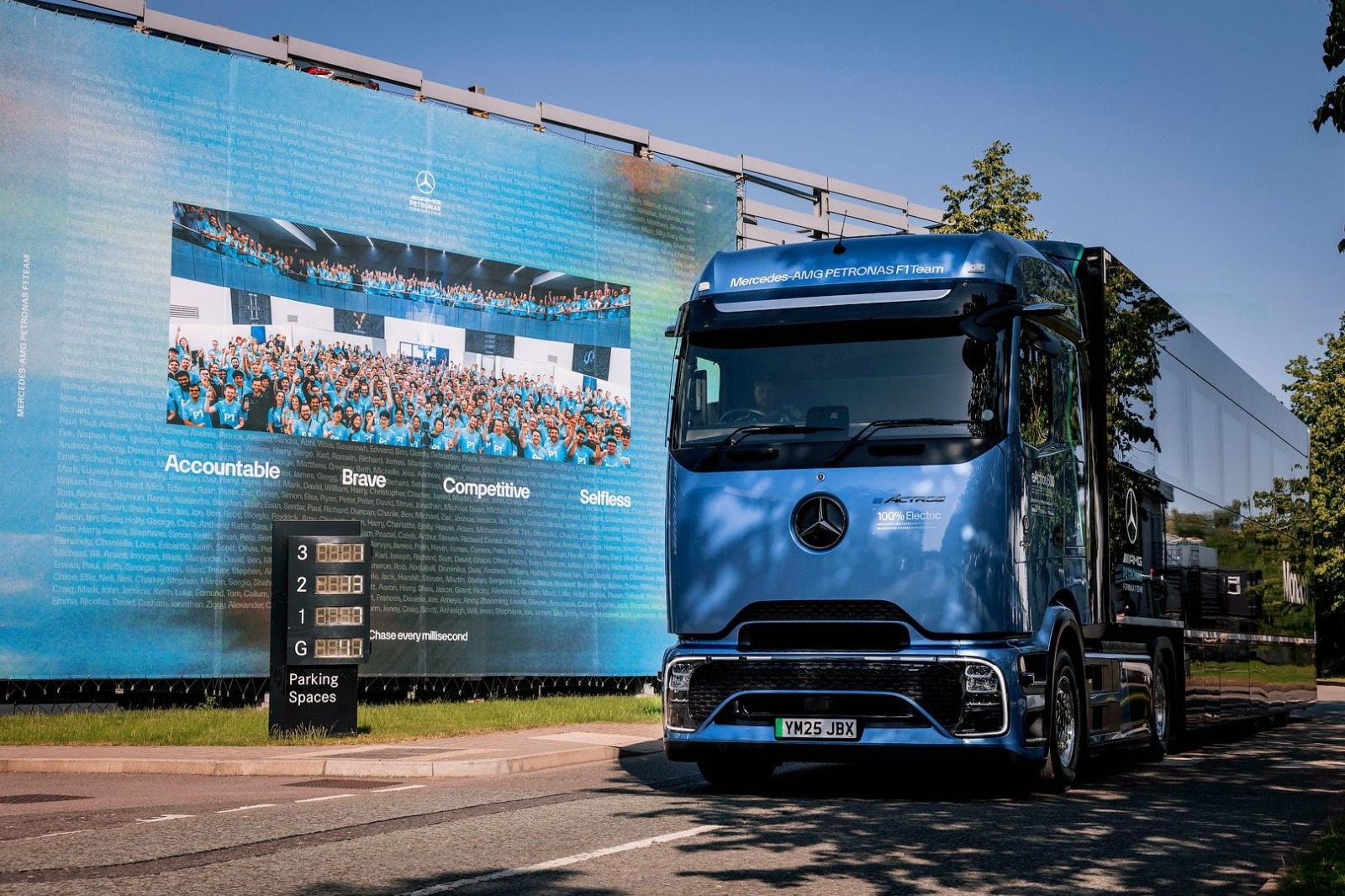
Mercedes has deployed the all-electric Mercedes-Benz eActros 600 for the 2026 European season, complementing a wider fleet of trucks powered by HVO100 biofuel.
Photo by: Mercedes
In the future, FOM will go even further in basing more equipment in regional hubs rather than flying it back and forth from the UK, and it is expected 50% of Formula 1’s current broadcast and related freight will be removed from air transport by 2030. For 2026 and beyond, twinning the Montreal and Miami races is also expected to yield further savings.
“Sustainability underpins every decision we make," Ellen Jones, head of ESG at Formula 1. "By doubling the sport’s investment in sustainable aviation fuel (SAF), making our first investment in sustainable maritime fuel, and continuing to work closely with promoters, teams and partners, we are driving further emissions reductions while accelerating the adoption of the latest technologies.
"These actions demonstrate our continued determination to lead through sustainable innovation. As we move towards our net zero by 2030 goal, the Future Race Operations Programme will deliver further significant reductions in the years ahead, alongside the full impact of calendar rationalisation, which will come into effect from the 2026 season.
"Together, these initiatives show that sustainable operations are not only possible at a global scale, but can be delivered without compromising the performance, ambition or spectacle that define Formula 1.”

Share Or Save This Story


Audi calls for F1 ADUO rethink amid exploit fears

One year on: How Red Bull changed post-Horner
Why Vasseur's steady hand is exactly what fervent Ferrari needs right now

WEC Brazil: Stevens leads front-row lockout for Cadillac, Toyota struggles

Marquez pessimistic for German GP despite sprint win

Why new MotoGP rules caused a processional German GP sprint

MotoGP German GP: Marquez leads Ducati sweep to take sprint win
Subscribe and access Autosport.com with your ad-blocker.
From Formula 1 to MotoGP we report straight from the paddock because we love our sport, just like you. In order to keep delivering our expert journalism, our website uses advertising. Still, we want to give you the opportunity to enjoy an ad-free and tracker-free website and to continue using your adblocker.


Top Comments