


Will any F1 teams face a scoreless season again?
OPINION: All 10 Formula 1 teams are off the mark after Melbourne, as McLaren and AlphaTauri took points in Australia. In F1's cost cap-levelled era, will a team ever suffer the ignominy of failing to score in a season again - and is the age of the backmarker team truly gone?

Following their respective forays into the points in Melbourne, McLaren and AlphaTauri’s top 10 finishes have guaranteed another season in which all 10 teams will end 2023 with at least a point to their names. McLaren stuffed 12 points into its hold luggage for the trip back to the United Kingdom, while AlphaTauri could probably pop its point for 10th place at Albert Park in its carry-on baggage.
One round sooner than in 2022, every team has formally opened its account by round three of the season in Australia, marking the second consecutive year in which all 10 teams have scored. It’s a welcome sight to see every outfit on the grid with a legitimate chance of claiming a tangible reward for its efforts. After all, the 2020 and 2021 seasons were both encumbered by one team ending the season with an ignominious zero to append the standings.
Williams, firmly in the doldrums, could not trouble the scorers in the COVID-hit 2020 season having scored just one point the year before, while Haas’s focus on 2022 ensured that its 2021 car - barely modified from the year before – was nothing more than a platform to prop up the rest of the field.
It’s not the first time that this has happened, of course. After all, every team scored points between 2016-2019, but there was some degree of luck involved in each of those cases. In 2016 and 2017, the respective bottom-placed teams, Manor and Sauber, were rescued from non-score seasons by Pascal Wehrlein. And Williams propped up 2018 and 2019 as it nosedived to the back of the grid. The correlation in those instances between success and cash flow is a somewhat consistent gradient, and it’s no coincidence that those teams were either in poor financial health or on the rebound from a period of dwindling coffers.
In the current era of budget caps and aero testing restrictions, plus each team boasting great franchise value amid the boom of contemporary F1, each outfit is on largely equal footing. Sure, some teams operated below the budget cap (and some, as per last year’s controversies, over it), but the differences are not likely to extend beyond a few million dollars – as opposed to the hundreds of millions separating teams a couple of decades ago.
When you consider the relative pace between teams in 2023’s iteration of the championship, the pecking order is a little something like this: Red Bull is at the front, followed by Mercedes, Aston Martin and Ferrari. Alpine heads the midfield, but after that is anyone’s game: McLaren, Alfa Romeo, Haas, Williams and AlphaTauri are all somewhat interchangeable. The team that leads that group will do so in response to the conditions of each race, rather than through an unassailable baked-in advantage.

The 2023 Formula 1 grid is arguably closer than ever as a result of the cost cap era
Photo by: Mark Sutton / Motorsport Images
In short, the mix of teams in contention is everything that the FIA set out to do with the cost cap. It doesn’t extend to the whole field yet, and Alpine currently ferries between the two divisions of the field akin to Charon crossing the River Styx. But in time, as homogeneity begins to develop thanks to the modern-day ruleset, more teams will mingle in a similar performance window. By that logic, it would be difficult for another team to face a scoreless season, should the FIA and F1 continue their current trajectories with the direction of the championship.
That’s not to say that it would be impossible but, with a plethora of evenly matched teams across 23 races, the wheel of fortune is much more likely to land on a points finish at least once per season than ever before. With just 1.3s separating the entire field (disregarding Sergio Perez’s inability to set a time) in Q1 at Albert Park, the field is tantalisingly close. You could fit that nearly twice over in between Alain Prost’s 2.3s pole gap over second-placed Eddie Cheever in qualifying for 1983’s French Grand Prix.
In the previous two seasons that featured a team on nil points, there were mitigating circumstances. Williams had 'just' 17 races to score points in the pandemic-shortened 2020 season, but could have theoretically broken its duck at Imola before George Russell crashed behind the safety car. The FW43 was also hamstrung by its aerodynamic sensitivity, making it very difficult to race with standard conditions.
It seems that the FIA has learned from 2010 teams’ struggles with minuscule lead times and has already got the ball rolling with expressions of interest
Haas in 2021, on the other hand, updated its VF-20 for the revised technical regulations by running a floor it had trialled in 2020’s Abu Dhabi Grand Prix practice sessions - and then doing very little beyond. As the full focus for the American team was on getting things right for the 2022 regulations rather than trying to salvage a flawed car concept, Haas effectively tanked its 2021 fortunes.
To suffer a non-scoring year in modern F1 would hence take either a lot of deliberate effort to put no resources into a certain year - or develop a car with an irredeemable flaw. But that’s with a grid of 10 teams. What if F1 and the FIA agree to add an 11th member to the club?
The big drawback of having 11 teams in the past has largely been the distribution of prize money. In the Bernie Ecclestone era of F1, only the top 10 teams were eligible for a payout. This was partly why grids started to shrink, as it was no longer sustainable to run a small outfit if it could not be competitive. Under Liberty Media, F1 has remained at 10 teams, but the prize money distribution would be different in that circumstance to ensure an 11th team could be guaranteed a longer-term future.

Haas was able to make its entry into F1 in 2016 a success thanks to its alliance with Ferrari
Photo by: Dirk Klynsmith / Motorsport Images
Regardless, a difficult first season for a start-up team would be a likely candidate for a no-score year. Building up a new team from scratch is a difficult feat and, with no data or reference points from the previous season, the challenge only increases. Haas was able to make a success of it in 2016 owing to a long gestation period and technical assistance from Ferrari, while the trio of new teams in 2010 were miles off the pace when they landed in F1. It seems that the FIA has learned from the 2010 teams’ struggles with minuscule lead times and has already got the ball rolling with expressions of interest.
In 2016, all 11 teams were able to make it onto the scoresheet – Sauber’s last-ditch ninth place courtesy of Felipe Nasr in Brazil knocking Manor down to the bottom of the pile. Manor’s inability to score in the previous season was not helped by a turbulent off-season, where the Marussia squad was on the brink of going out of business before the team was purchased. The MR03B was only a lightly upgraded version of the 2014 car, which was already among the backmarkers despite having scored two points thanks to the late Jules Bianchi’s Monaco heroics.
The 2014 season was the most recent 11-team season with zero scores – neither Sauber nor Caterham bothered the points as both teams produced heavy, bulky, inefficient designs. In these instances, it was again the lesser-funded teams whom points eluded, personified in the late 1990s and early 2000s by the Minardi squad.
A team in F1 purely as a passion project, Minardi rarely scored points and mainly did so through attrition or weather-affected races. Income came from a rotating cast of drivers and small Italian industrialists, not prize money, and sales to Gabriele Rumi and later Paul Stoddart kept the team afloat in its later years. Its cars were neatly designed, but underdeveloped and usually powered by sub-par engines. By 2001, for example, the Ford VJ powerplant the team used was approaching four years old – the Cosworth-penned works Ford engines were considerably more advanced by this juncture.
That couldn’t really happen in modern F1, where teams are guaranteed up-to-date power units and it makes more business sense to buy in components that have little bearing on performance. With parity in terms of budgets, there’s also no longer the field spread created when the manufacturing giants are spending 10 times the amount of those at the back.
In a couple more years, F1 would certainly be able to handle an 11th squad, particularly if it has enough of a run-up to join the melee for points. To use Andretti’s interest as an example, the team has been busy hiring a plentiful supply of technical personnel with vast experience of F1. If it was afforded the chance to go into F1, it’s possible for the team to start brightly if it gets the right funding and a potential Alpine/Renault link-up comes off.
The other outfits with an apparent interest in an 11th entry include Hitech, which rumour suggests is exploring links with Mercedes, and the Panthera and Formula Equal submissions. Panthera has cropped up in new team conversations before, although little is known about it. Meanwhile, Craig Pollock’s equal-gender Formula Equal project has emerged recently as a contender – and Pollock has been here before, with BAR in 1999. Back then, the tobacco-funded Brackley squad took Tyrrell’s place as the 11th entry...and failed to score a point.
With that in mind, the only things that could realistically stop a team from going through a whole season without scoring – aside from a very poor car or sacrificing a year – would be some kind of series of freak events. Alternatively, there’s Pollock betting that Formula Equal will win its first F1 race. It hasn’t been a particularly good omen in the past.
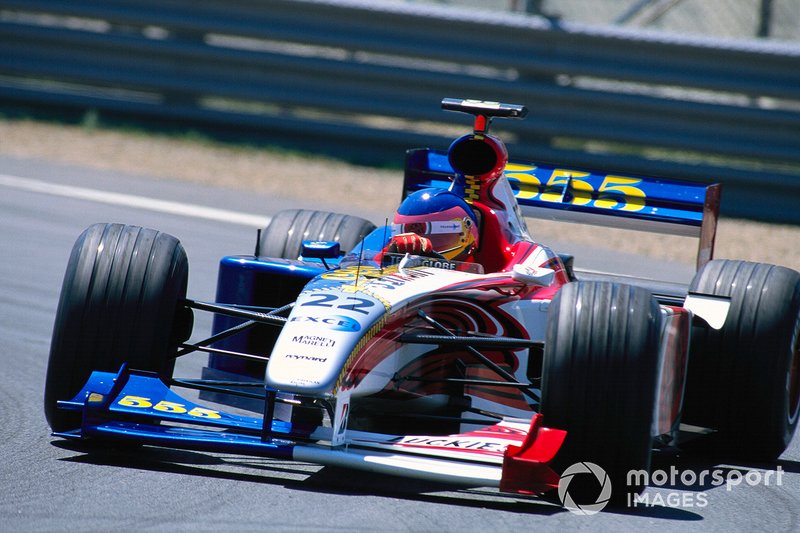
BAR failed to score points in its debut season in 1999, but would a well-prepared new outfit in today's climes stand a better chance?
Photo by: Rainer W. Schlegelmilch / Motorsport Images


Lights, Camara, action: How Haas picked F1's latest rookie for 2027

Horner's inside story of how Red Bull built its own F1 engine

Why Mercedes' latest 2026 F1 update is no downgrade

Singapore Grand Prix Driver Ratings 2026

What we learned from the 2026 F1 Singapore GP sprint race and qualifying

The political minefield set out by F1’s recent cost-cap grievances

What caused Mercedes' pace deficit at Sepang despite upgraded W17?

Three kings: F1's generational stars shone at Sepang

How Toyota destroyed the competition to seal the WEC crowns

McLaren retains Fornaroli as F1 reserve and hands him WEC programme for 2027

How Andrew Jordan realised his teenage rallycross dream

Inside the competition building F1’s future engineering talent
Subscribe and access Autosport.com with your ad-blocker.
From Formula 1 to MotoGP we report straight from the paddock because we love our sport, just like you. In order to keep delivering our expert journalism, our website uses advertising. Still, we want to give you the opportunity to enjoy an ad-free and tracker-free website and to continue using your adblocker.


Top Comments