
Why the WRC's 'modern Group B' era was rallying at its bonkers best
The World Rally Championship has brought down the curtain on the aggressive, aero-laden generation of cars first introduced in 2017 that have been likened to the 1980s Group B icons. As the championship prepares to begin a new era of Rally1 hybrid cars, its stars explain just why the outgoing machines were so special

Sporting icons are often only truly recognised retrospectively. In years to come, the mind boggling beasts born out of the World Rally Championship’s 2017 regulations may perhaps be remembered as perhaps the greatest ever.
There can be no more fitting a tribute than labelling the cars that competed from 2017-2021 as the 'modern Group B' - a future take on the bonkers turbo-charged tearaways produced by Audi, Peugeot, Ford and Lancia during the 1980s that truly put rallying on the map.
The World Rally Championship may be heading towards a new exciting hybrid future in 2022, but it would be remiss not to acknowledge the most recent era of cars that have graced the world’s most challenging roads for the past five years.
When drivers unanimously agree on any aspect of the sport, then you know something must be special. And as the curtain fell on 'modern Group B' cars at Rally Monza in November, tributes from drivers and fans were plentiful.
“They were simply amazing cars, I think everybody enjoyed it,” said Sebastien Ogier, who won four of the five titles during the period with M-Sport Ford and Toyota, either side of a single season at Citroen.
Hyundai’s Ott Tanak, who scored his first WRC win in 2017 at M-Sport before winning the 2019 title with Toyota, added: “I’m lucky to have been able to drive so many different cars during this generation of WRC. They will go down in history as one of the best, I think.”
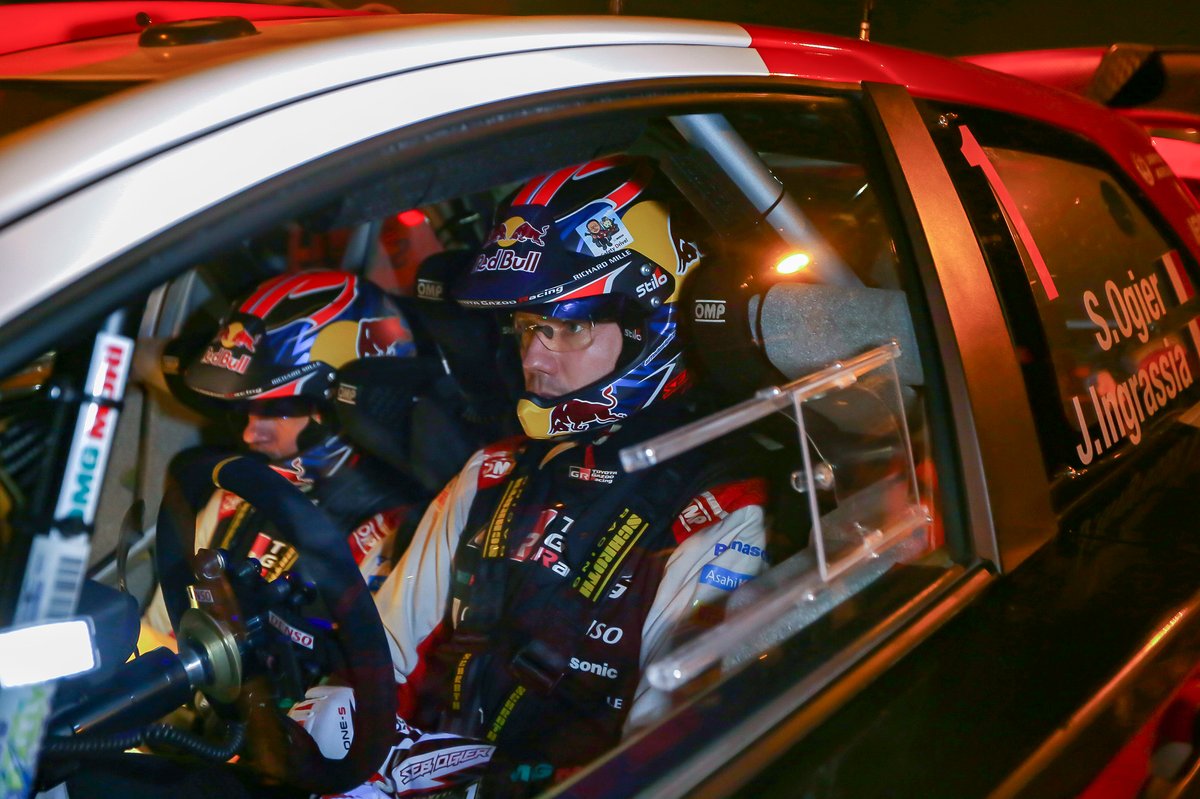
Ogier won four of five titles during the high downforce era
Photo by: Toyota Racing
When the FIA and WRC announced a raft of new regulations to be introduced in 2017, there was plenty of excitement in the service park, along with plenty of scepticism. The plan was a simple one - to increase the speed, increase the use aerodynamics to make an all-round more extreme product.
There was nothing inherently wrong with the generation of cars that had gone before. In fact, the Volkswagen Polo piloted by Ogier to four consecutive titles between 2013 and 2016 had become an icon in its own right. But these new breed of beasts born in 2017 had something special from the outset.
Power was increased from 315 to 380 horsepower, courtesy of a 36mm restrictor being fitted to the 1.6-litre turbo charged engine. An extra 55mm of width for manufacturers to play with created wilder looking beasts that grew several aerodynamic appendages, including whopping great rear wings, to significantly increase downforce and allow the drivers to go faster than ever before. This aided by a drop of 25kg in weight, down to 1175kg, promised to deliver a concoction that proved to be something special.
PLUS: How an aero revolution transformed the WRC
There was some scepticism that the regulations had gone too far and the cars would be too fast. But these concerns were quickly consigned to the past when the new machines from Toyota (Yaris), Hyundai (i20), Citroen (C3) and M-Sport Ford (Fiesta) hit the stages, providing the WRC a real injection of excitement.
"The regulations we have had since 2017 have probably provided us with the ultimate rally car, and it’s been getting better each year. The level is mind blowing" Craig Breen
“As a racing driver, you are always looking for more performance,” said Ogier at the launch of the new regulations. “The extra power will definitely make the driving more spectacular for the fans.” His prediction would ring true.
Not only were the cars spectacular, but the competition between the four marques was incredibly close. It was a combination that made the WRC must-watch television for the purist, while also grabbing the attention of the causal passer-by.
It was M-Sport that hit the ground running with its extreme-looking Fiesta, piloted by Ogier, that dominated the first two years of the regulations. The Frenchman netted two wins in 2017 and was inside the top five on every rally he finished to secure the title, while M-Sport swept the manufacturers’ title with Tanak adding two wins of his own.

Ogier swept to back-to-back titles with M-Sport Ford in 2017 and 2018 at the start of the rules set
Photo by: McKlein / Motorsport Images
Ogier repeated the feat in 2018 but M-Sport lost the manufacturers' crown after a hotly contested fight in which title-winner Toyota - now led by Tanak, a significant upgrade on Juho Hanninen - runner-up Hyundai and M-Sport were split by just 44 points.
Toyota’s development of the Yaris came to the fore in 2019 as Tanak took the title after Ogier returned to Citroen, in a very different position to the team he had left at the end of 2011. Yet it was Hyundai that emerged with the best car, as the South Korean marque pipped Toyota to the manufacturers’ crown by 18 points, despite early points leader Thierry Neuville's mid-season dry spell. It was to be the final year the C3 turned a wheel in anger as Citroen exited the WRC, Ogier also beaten to second by Hyundai's Neuville.
Now with Tanak in its ranks after his defection from Toyota, Hyundai would maintain its title in 2020 - although the driver’s title was contested between new Toyota signings Ogier and Elfyn Evans, the former coming out on top in a seven-round campaign that was badly impacted by the COVID-19 pandemic.
The cars were at their fastest and most spectacular in 2021, as Toyota, Hyundai, M-Sport developed their machines to the maximum in their swansong year. Hyundai’s i20 was the fastest, but proved fragile, while Toyota claimed a drivers’ and manufacturers double as Ogier again defeated Evans to notch up an eighth world title in his final full-time season.
PLUS: Why Ogier's WRC swansong was a season to savour
With the new Rally1 regulations on the horizon, drivers, teams and fans relished their final opportunities to see these cars on the limit in manufacturer competition (they will still be eligible to compete next year, albeit on a grandfathered basis with a power reduction). If you were fortunate enough to be watching first-hand as they blasted through a forest stage, tackled a jump or drifted round a tricky hairpin, it the sight would live long in the memory.
Perhaps the arena where the cars and drivers were most able to showcase the raw power within was October's Rally Finland. Its blend of high-speed, fast flowing forest gravel roads, ladened with jumps and crests, provided scenes rally fans will hold onto for some time.
It is not only the fans that will forever love this generation of cars though. A mere mention of the cars being in their final year prompted drivers to wax lyrical about their capabilities.
“I will be forever grateful to have been part of this generation of WRC; it has been something very special and we’ve had some amazing moments,” said Craig Breen, who drove the Citroen in 2017-2018 and the Hyundai from 2019-2021.
“The regulations we have had since 2017 have probably provided us with the ultimate rally car, and it’s been getting better each year. The level is mind blowing. In terms of technology and pure performance, there is nothing on this planet like these cars.”
“I am pretty sure we have lived through one of the best eras in WRC over the past five years because these cars have been super exciting to drive and watch. The competition has been so close” Thierry Neuville
Even, Ogier, who has perhaps seen it all in the WRC, admitted these cars were “simply the best” and at times their speed scared him.
“When you give the best rally drivers some competitive cars the most important is they are not too different from each other and then there will always be a show,” said Ogier.
“But these ones had this extra little bit of craziness in it, like remembering the Group B times with all these fans. The speed we reach now was sometimes started to scare me a little bit I have to be honest.”
The last event for these cars left drivers quite emotional with Hyundai’s Thierry Neuville declaring that the period has been the best the WRC has witnessed to date. Neuville will forever have the last three stages wins in these cars to his name.
“I am pretty sure we have lived through one of the best eras in WRC over the past five years because these cars have been super exciting to drive and watch,” said Neuville. “The competition has been so close with all teams on a similar level of competition.”
The Belgian, who finished runner-up from 2017-2019 while chalking up 13 rally wins during the last five years, is even trying to ensure he gets to keep an i20 to add to his own collection of rally machinery.

Thierry Neuville, Martijn Wydaeghe, Hyundai Motorsport Hyundai i20 Coupe WRC
Photo by: Vincent Thuillier / Hyundai Motorsport
“I would like to [keep one of the cars], there have been some discussions already,” he added. “I have more or less all the cars I have driven in the past except the Hyundais so it is time to fill the garage with some more cars.”
The past five years will be remembered as a golden age but that doesn’t mean a new period just as spectacular won’t come along in the future. In motorsport, if teams and championship stand still they will get overtaken and next year the WRC has opted for a rules overhaul it hopes will see the championship fit into a world much more concerned about carbon footprints and saving the planet.
Next year’s Rally1 regulations sees the introduction of hybrid power and 100% sustainable fuel to an all-new breed of beasts capable of producing 500 horsepower in bursts, thanks to hybrid power. The cars will be heavier and potentially slower than their wild predecessors to begin with, but there are many convinced the Rally1 cars could prove just as spectacular as the 2017 cars.
Toyota’s technical director Tom Fowler is among those confident this new breed of rally car will create another set of golden memories, once teams develop and understand their new 2022 challengers.
“We are at the start of the regulation and it is my job and the rest of the WRC engineers to keep pushing the regulation for the next few years,” said Fowler. “I’m quite sure within the space of the first few rallies, half a year or a year we will be talking [about] how fast these new cars are as well.
“In terms of the engine performance and the new hybrid motor the ability for this car to accelerate is incredible. I think we will be there or thereabouts in a short period of time.”
Before the WRC’s ushers in a new generation Autosport was given exclusive access to M-Sport’s Ford Fiesta to understand what made the car so special and some of changes that will adopted to the team’s new Rally1 Ford Puma for 2022.


The USA’s WRC return and 2027 key calendar questions answered

WRC expands 2027 calendar to 15 rounds as USA, UK return

Ogier to skip Monte Carlo with other WRC 2027 plans undecided

Neuville assessing his future options with WRC 2027 drive unconfirmed

A story of persistence as Evans' long wait for WRC glory finally ends

How Evans made WRC history in Hollywood blockbuster Sardinia decider

New WRC champion Evans relieved after “surreal” Sardinia title showdown

Solberg has no regrets after WRC title near-miss: “It hurts a lot”

Why "crazy" power unit success is so meaningful for Red Bull - and for F1

McLaren targets Norris’ costly fuel system issue with Singapore F1 power unit fixes

How Ford is "hitting milestones" in preparation for WEC Hypercar assault

Audi F1 drivers reveal biggest engine limitation – and why they’re not worried
Subscribe and access Autosport.com with your ad-blocker.
From Formula 1 to MotoGP we report straight from the paddock because we love our sport, just like you. In order to keep delivering our expert journalism, our website uses advertising. Still, we want to give you the opportunity to enjoy an ad-free and tracker-free website and to continue using your adblocker.


Top Comments