


Why the intensity of F1 2021’s title fight plays into Red Bull’s ethos
After spending so many difficult seasons watching Mercedes clean up in Formula 1’s hybrid era, Red Bull has finally put together a package capable of fighting for the world championship. It’s therefore no surprise to see Max Verstappen and his team attacking with zero compromise in pursuit of glory
Red Bull has always approached Formula 1 on the front foot. It’s an attitude encapsulated in the unofficial company philosophy: “No risk, no fun.” Another cliché to describe it, perhaps, would be: “Go hard or go home.”
It is a credo, a modus operandi, that goes right back to Red Bull’s early days in Formula 1. When Red Bull joined the grid back in 2005, taking over the Jaguar team, Christian Horner decided the best way to guarantee success was to sign the greatest designer of his age.
So Red Bull’s team principal went after Adrian Newey and tempted him away from McLaren at the end of 2005, a little over four years after McLaren had successfully fought off an attempt by Jaguar to do the same.
It was evident, also, throughout the title-winning years of the early 2010s, when Red Bull explored the limits of the technical regulations on a number of fronts in a manner that angered its rivals and even caused the occasional raised eyebrow and roll of the eyes from the late Charlie Whiting, then the FIA’s F1 director.
And so it is obvious again in 2021, a season in which Red Bull has found itself in a title fight for the first time in eight years.
In Max Verstappen, Red Bull has found in many ways its perfect figurehead. A racing driver who simply refuses to compromise, who so far has refused to back out of any on-track confrontation with championship rival Lewis Hamilton, even if by doing so he is taking potentially damaging risks.
This is a team packed full of talent and ability, which never lost its hard competitive edge, even through the years of Mercedes domination when victories were but crumbs from the Silver Arrows’ table.

Verstappen is an ideal figurehead for Red Bull's 'no compromise' ethos
Photo by: Charles Coates / Motorsport Images
Red Bull honed the finest pitstops in the field, kept a light-footed improvisational approach to race strategy, produced competitive cars, although the engines did not match them. All this made Red Bull the most consistent challenge to Mercedes through the hybrid era, even if Ferrari was the team that got closest to upsetting the Brackley/Brixworth bandwagon in 2017-18.
So it should be no surprise that now, when Red Bull finally has a car and engine package with which to take on Mercedes on a level playing field, the result is a battle full of intensity, bite and combustibility.
It’s the rules
Red Bull’s conversion from occasional threat to consistent frontrunner has created one of the most compelling F1 seasons for years. Not since 2012, when Red Bull’s Sebastian Vettel narrowly triumphed over Ferrari’s Fernando Alonso, have two drivers from different teams competed so closely for the title for so long.
But 2021 is different from 2012 in a number of ways. First, in 2012, there was no doubt the Red Bull was a faster car. Alonso, for most of the second half of the season, was fighting a rear-guard battle against a rival in far superior machinery, trying to protect a points lead established in remarkable circumstances in the first part of the year.
Red Bull’s average qualifying deficit to Mercedes in the first half of last year was 0.8s; in the second half it was down to 0.3s, and Red Bull went into the winter, after closing 2020 with a dominant victory in Abu Dhabi, confident of making further gains
And the inter-team fight, though tense at times, plumbed nowhere near the depths of Red Bull versus Mercedes this year. Plenty of other teams were competitive that year, and that diluted the Vettel-Alonso fight because they were not that often fighting for the same position on track at the same time.
This year, the dynamic is different. Red Bull has as fast a car as Mercedes, and Verstappen and Hamilton have been going at it toe-to-toe from the off. They have contested almost every race, and the tension has ratcheted up each time, with confrontations both on track and off.
But let’s rewind a little. For this was not exactly an expected turn of events after Mercedes steamrollered the 2020 season, taking 13 wins to Red Bull’s two.

Comfortable victory in 2020 Abu Dhabi finale was a warning sign of what was to come
Photo by: Glenn Dunbar / Motorsport Images
There were signs that Red Bull was getting closer. It made progress through the year, after a slow start with a car that had a new aerodynamic philosophy – taking the approach to under-nose airflow Mercedes pioneered in 2017, and which it took Red Bull time to understand.
Red Bull’s average qualifying deficit to Mercedes in the first half of last year was 0.8s; in the second half it was down to 0.3s, and Red Bull went into the winter, after closing 2020 with a dominant victory in Abu Dhabi, confident of making further gains.
But it was the rule change ahead of 2021 that made the key difference. To keep cornering speeds under control, revisions were mandated at the back of the cars. And these, it is now apparent, affected Mercedes more than Red Bull.
Mercedes – pioneer of the low-rake design approach – was hit with a double whammy. Not only was its car more badly affected by the rule change, but the team found it harder than usual to claw back lost performance, too.
Red Bull, meanwhile, with a high-rake car, which generates its under-floor downforce in a different way, was not as badly affected. In addition, Red Bull used its permitted development ‘tokens’ to change the gearbox casing on its car, allowing designers to adopt swept-back rear suspension – another Mercedes innovation. This opened up space at the back of the car, created more rear downforce, and calmed the RB16’s inherent nervousness, its biggest weakness in 2020.
“Max instantly felt the new car was a decent step from the previous one,” says Newey, “and was very complimentary. Coming out of the (pre-season) test, we felt we had a competitive package. But you never really know where that’s going to be.
“It took the Bahrain Grand Prix to confirm that, yes, we were competitive. We didn’t win that one – but it’s been nip and tuck since then.”

Newey says Bahrain served as proof of its concept, despite missing victory
Photo by: Charles Coates / Motorsport Images
Always ready to win
After eight years out of the title fight, it might be expected that Red Bull would have to do a fair bit of mental resetting to get itself into the right mindset to take on the most successful Formula 1 team in recent history.
In fact, Horner says that was not the case, and his words reflect the fact that Red Bull’s essential nature as a team has never changed over the intervening period. The only difference in that time has been the competitive level of the car and engine combination.
“The senior structure of the team is predominantly the same as when we were running for those championships,” Horner says. “We’ve had tremendous continuity over the years. The majority of the pit wall was there back in the halcyon days of 2010-2013. So, I never really felt there’s been a gearing up. It’s just been a case of, y’know, we need to take opportunities with both hands.
"We lost out in 2009 but that, and I think the experiences of winning two very tight battles in 2010 and 2012, have moulded us, and given us a level of resilience that comes in very useful now. We know how to be the hunter and the hunted, which is a definite strength" Adrian Newey
“As a race team, we’ve been pretty sharp. We’re trying to capitalise on those opportunities and ensure that we’ve got a car that’s capable throughout the year. It’s been such a long period since anybody has given Mercedes any real challenge. It’s great and the whole team is loving being in a competitive position, loving going to races with a chance of winning them instead of taking opportunistic wins. There’s just a real sense of motivation, atmosphere, energy, within the whole team.”
Newey adds: “One of the great things about Red Bull Racing is that we’ve always had a good atmosphere in the team and that’s meant we’ve also had very good stability in the workforce, going back to a time even before we were first able to mount a title challenge.
“We lost out in 2009 but that, and I think the experiences of winning two very tight battles in 2010 and 2012, have moulded us, and given us a level of resilience that comes in very useful now. We know how to be the hunter and the hunted, which is a definite strength.”
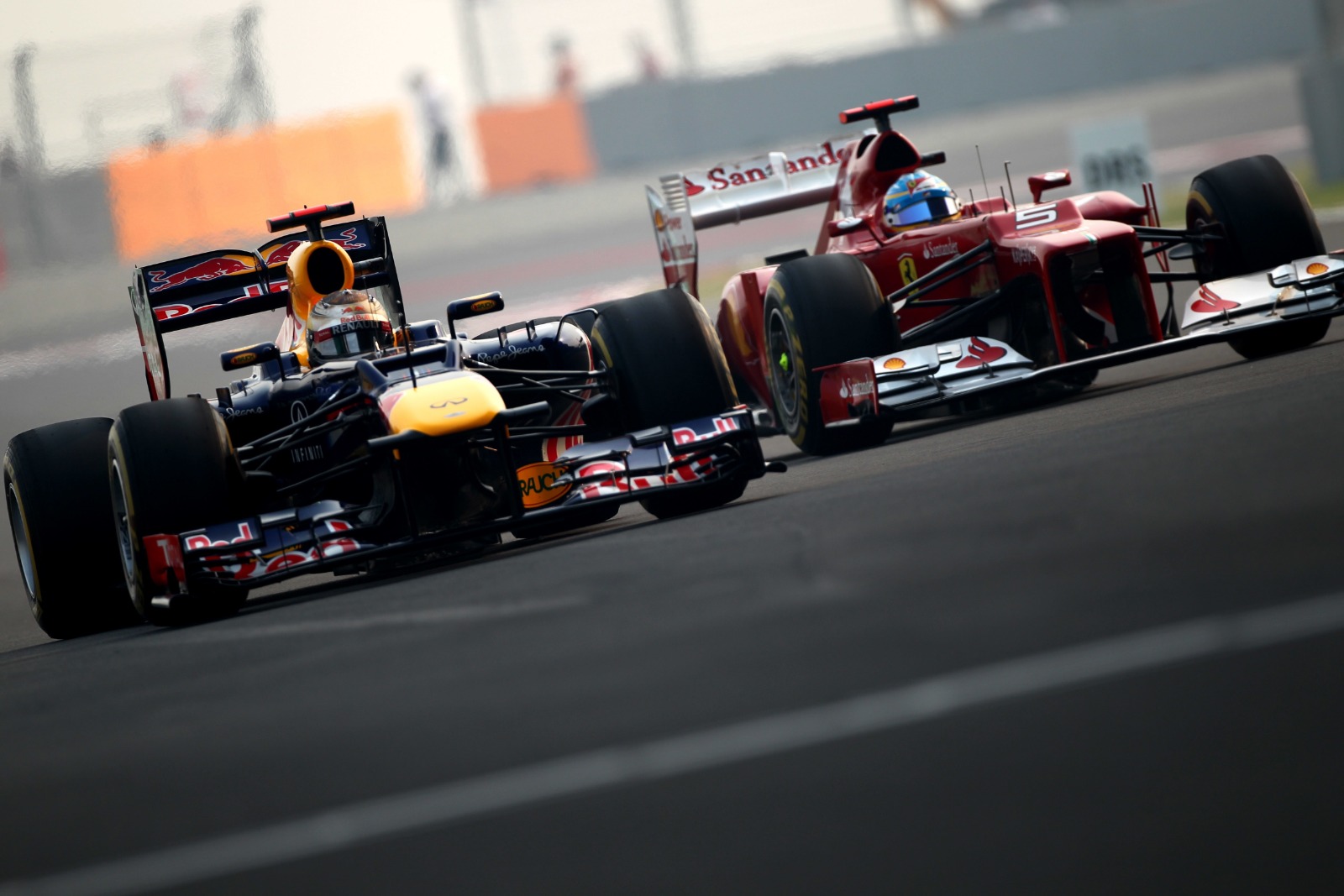
Resilience developed from Vettel's title fights with Alonso in 2010 and 2012 (pictured here in India) have proven useful in 2021
Photo by: Motorsport Images
All-out war
Red Bull and Mercedes have been fighting their battle on all fronts.
Mercedes, seeing Red Bull had a car advantage, has been seeking ways to reduce it. Mercedes questioned the flexibility of Red Bull’s rear wing – a technology several other teams were exploiting, too – and won a clarification from the FIA that required it to be strengthened. Mercedes also asked for a clarification on what was possible with pit equipment, which led to a second review that slowed pitstops.
Hamilton, for his part, has not shied away from casting aspersions on Red Bull – whether it be following the tyre failures in Baku, which Pirelli said were caused by teams (legally) running their tyres below expected pressures, and which led to yet another clarification; or questioning why it seemed suddenly to find a straightline speed advantage when Honda’s second engine of the year was introduced, when power-unit design is supposed to be frozen in-season.
All of these have been annoyances for Red Bull, but this last accusation created particular resentment, because the reality was the RB16B’s gain was down to developments that had generated greater downforce from the car and underbody, allowing for a set-up that runs less rear wing for the same ultimate downforce level. And this was a reflection of Red Bull winning the development war, at least in early summer.
In the final year before engine partner Honda officially says “sayonara” to Formula 1, Red Bull finally has an engine from the Japanese company that is on a par with Mercedes – and has a key advantage in holding on to electrical deployment for longer on the straights. Through the first half of the season, Red Bull also threw more development onto its car than Mercedes, although a couple of key Mercedes upgrades since the British Grand Prix have redressed the balance.
Like Mercedes, Red Bull is having to balance progress in 2021 against designing an all-new car to a revolutionary change in technical regulations for 2022 in the first year of a cost-cap. But the equation is different for the two teams.
Red Bull has found aerodynamic development easier to come by than Mercedes, and the lack of it made it easier for Mercedes to focus earlier on 2022. At the same time, having been granted a real chance to win a first title in almost a decade, Red Bull wants to ensure it puts everything it can into seizing the opportunity.
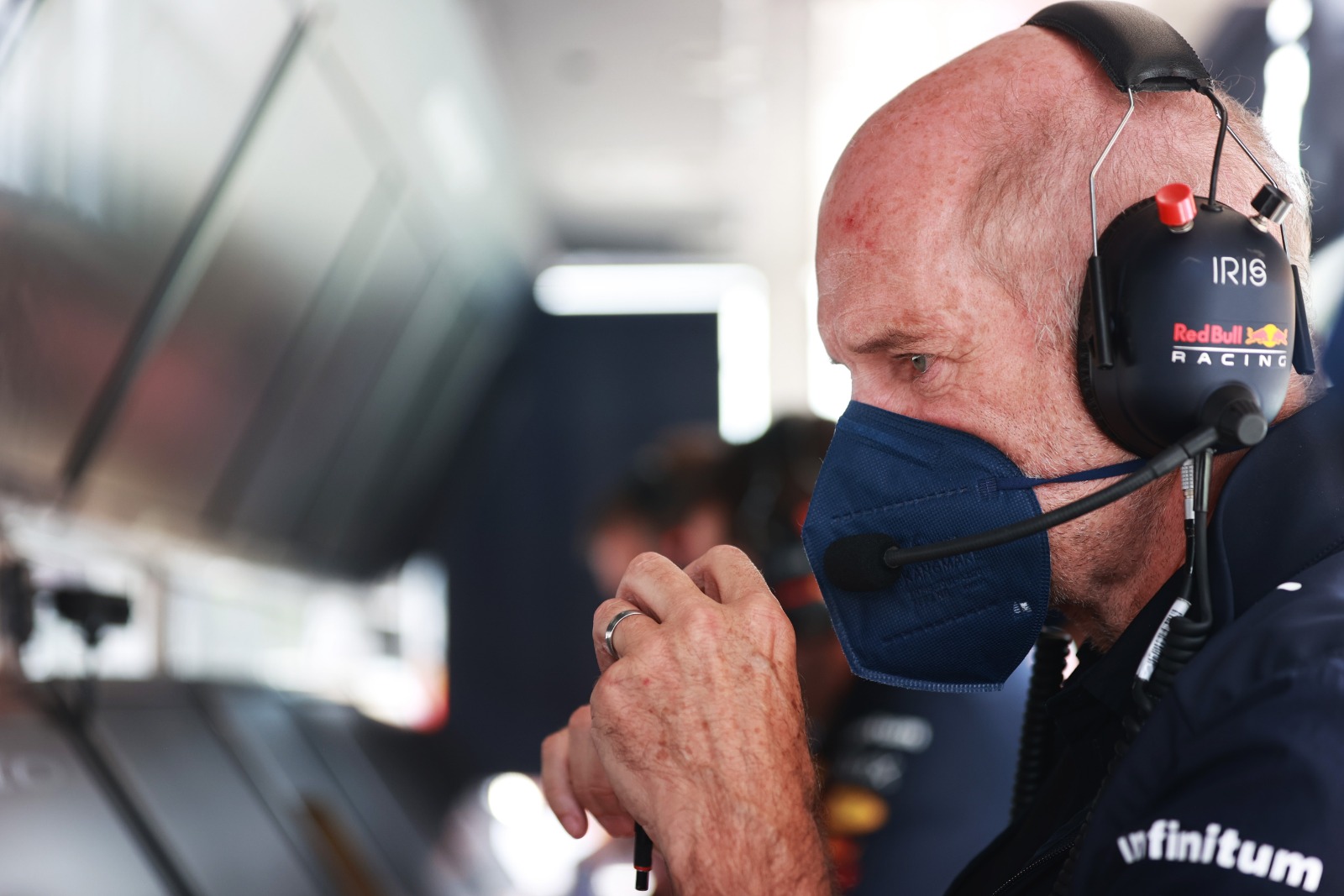
Newey says he "can’t remember a time" when behind-the-scenes politicking was so prominent
Photo by: Mark Thompson/Getty Images
Overall, Mercedes’ behind-the-scenes efforts to slow its rivals have not gone down well at Red Bull. Horner called the pitstop rule change “disappointing”. On the manoeuvrings over technical issues, Newey says: “In many ways it is a compliment to the team to find ourselves under such scrutiny from others.
“We have experienced this before, but I can’t remember a time when we have received the same level of behind-the-scenes politicking and lobbying against our car. Possibly if you look back to when we were exploring aero-elastics in 2010-11, then we were under constant scrutiny and would adapt to each changing set of regulations.”
But the rivalry reached its zenith – or nadir, depending on how you look at it – following the collision between Hamilton and Verstappen at the British Grand Prix.
"Formula 1 is a competitive business. It’s competitive on track and it’s competitive off track. The competition is fierce. And in a competition like we are in, it’s all about marginal gains and leaving no stone unturned" Christian Horner
Horner did not pull his punches. He called Hamilton’s driving “an amateur mistake, a desperate move” and “a massive risk”. He said the move was “never on”, and described the 10-second penalty the seven-time champion received for the incident, and from which he fought back to win the race, as “menial”.
Red Bull took it one step further in its submission to the stewards seeking a review of Hamilton’s penalty, writing that “Hamilton knowingly did not avoid contact with Max’s car”. They questioned whether the stewards had been influenced by a visit to their office by Toto, asking whether “the stewards were persuaded to seek his advice in making the decision on account of the standing his team and his driver purport to hold with the FIA”.
Mercedes took exception to this, saying Red Bull’s claims “over-stepped the line” and were both “below the belt” and “a concerted attempt by the senior management of Red Bull Racing to tarnish the good name and sporting integrity of Lewis Hamilton”.
Wolff said he wanted to “bring a bit of respect back into the discussion”. Horner responded by describing Mercedes’ statement as “a little antagonistic”, and insisting: “At no point did we question the objectivity of the FIA.”

Silverstone clash sparked a war of words between the team bosses of Mercedes and Red Bull
Photo by: FIA Pool
Outside of the two teams directly involved, some compared Horner’s reactions to the Silverstone crash with his response to a collision between Verstappen and Lance Stroll’s Racing Point in practice at last year’s Portuguese GP.
The two incidents were not the same – Hamilton was all but completely alongside on turn-in at Silverstone, which Verstappen never was in Portimao – but there were obvious similarities. At Portimao, it was Verstappen who had been trying to overtake, and whose front wheel hit Stroll’s rear in a high-speed corner, as Hamilton’s had Verstappen’s.
“If that had been a race,” Horner said, in defence of his driver, “Max would have been deemed to be up the inside, therefore the car on the outside should have given way.”
He couldn’t, as some rivals pointed out, have it both ways.
Horner’s rhetoric was less confrontational after their second collision at Monza, but both he and Wolff have said there is little they can do to stop another incident happening again if one or other driver chooses not to avoid one.
Whatever it takes
Readers will have their own views on the rights and wrongs of all these controversies – and the ones that are doubtless to come. Ultimately, though, all this is a reflection of a singular commitment to winning.
“Formula 1 is a competitive business,” Horner says. “It’s competitive on track and it’s competitive off track. The competition is fierce. And in a competition like we are in, it’s all about marginal gains and leaving no stone unturned.
“It’s the first time Mercedes have been in this position in the hybrid era and our focus is on trying to get the most performance we can out of our drivers, out of our cars, out of the whole team. And of course that rivalry will be intense.”
Andrew Benson is BBC Sport’s chief F1 writer

Neither Hamilton or Verstappen were willing to back out at Monza, resulting in both crashing out
Photo by: Andy Hone / Motorsport Images

How Ratzenberger beat the odds to realise his cruelly short-lived F1 dream

F1 uncovered: A weekend behind the scenes with a chief mechanic

When McLaren was pipped by Red Bull in a modern F1 classic

The big opportunity Sainz’s Williams switch affords to F1’s latest centurion

Inside the science of F1 fuel

How F1’s plan for rotating races could look in practice

The early decisions that set Sauber’s rookie for success

How F1 media coverage has evolved in line with its subject

Mekies extends contract as Red Bull's F1 team boss

What to expect from WEC's Barcelona debut

Acosta proposes new idea for monitoring tyre pressure in MotoGP

Horner's inside story of how Red Bull built its own F1 engine
Subscribe and access Autosport.com with your ad-blocker.
From Formula 1 to MotoGP we report straight from the paddock because we love our sport, just like you. In order to keep delivering our expert journalism, our website uses advertising. Still, we want to give you the opportunity to enjoy an ad-free and tracker-free website and to continue using your adblocker.


Top Comments