


How did the 2023 F1 rookies fare in Bahrain?
The new faces on the 2023 F1 grid experienced varying degrees of success in their first outing as fully minted full-time drivers. But how did the trio of Nyck de Vries, Oscar Piastri, and Logan Sargeant stack up, and what do the numbers tell us about their races in Bahrain?

In many regards, it’s a lot more challenging to be a rookie driver in Formula 1 in the modern era. Testing is considerably more limited than it ever was, and the days of newcomers being granted endless track time in closed-door sessions away from the prying eyes of the media offered a low-pressure environment for them to learn their craft.
Consider some of the great rookie performances of the last 20 years, and the context of unadulterated odometer-ticking days at Jerez or Barcelona perhaps knocks some of the shine off – Lewis Hamilton’s podium first time out in Melbourne and Sebastian Vettel’s points-scoring run at Indianapolis were aided considerably by testing programmes and the days of third cars in practice sessions respectively.
Sure, Nyck de Vries did a full race last season and, along with Logan Sargeant, got some decent mileage in practice sessions last year. In the meantime, Oscar Piastri had gathered experience in young driver tests and testing programmes in an old car, but their experience can be considered fleeting in comparison to the liberty that rookie drivers of the past were afforded.
For the 2023 crop of first-year students, there’s thankfully some balance in that the Bahrain Grand Prix circuit is quite forgiving. There’s plenty of run-off and, although that’s often met with justified derision, it ensures that a driver new to F1 has to do something really special to make a complete dog's dinner of their debut. Just ask Nikita Mazepin.
Each of those who graduated to F1 to participate in the 2023 opener had a different story to weave throughout the 57 laps and, from their data, it’s possible to gauge how they got on. We’ll analyse their performances relative to their team-mate in qualifying and the race and lean on some of the relevant data in practice to hopefully yield a clearer picture.

De Vries appeared to be evenly matched with team-mate Yuki Tsunoda straight out of the gate
Photo by: Red Bull Content Pool
De Vries: On par with team-mate Tsunoda
Let’s address the elephant in the room now: this was not de Vries’ first race. His unlikely run to ninth at Monza last year, substituting for the appendicitis-struck Alex Albon at Williams, was arguably the drive that put him on the map for AlphaTauri to consider as a replacement for Pierre Gasly. Once the Italian squad’s efforts to bring Colton Herta across the Atlantic was nixed owing to the FIA’s superlicence points requirements, de Vries was in.
But jumping to a car on the fly and making a full-time race debut are very different experiences. Given the difference in team, he began Bahrain as more than just a quasi-rookie – he's a newly minted F1 driver, rather than a reserve option. Thus, it’s justifiable to classify the 2020-21 Formula E champion in the same bracket as Piastri and Sargeant as a bona fide newcomer.
Going by their FP2 results, since it was the sole representative session of the weekend preamble having been held at nightfall, he appeared to be evenly matched with team-mate Yuki Tsunoda straight out of the gate. Tsunoda’s a dab hand at the Bahrain circuit, so was always going to provide stern competition, but their first quick laps at the start of the session on softs were separated by just eight-hundredths – the Japanese with a slight edge.
On their longer soft runs towards the end, the two again were very comparable, albeit with Tsunoda displaying slightly greater consistency in their laptimes. But Tsunoda’s greater experience of the Pirelli tyres created a larger gap in qualifying, and de Vries admitted after Q1 that he’d not been able to get the tyres into the right performance window for the last run as the track had evolved considerably.
To compare the difference, Tsunoda set a 1m31.747s on his second run, with de Vries logging a 1m32.121s, a 0.374s delta between them. But de Vries could not improve on his third and final run as Tsunoda could; the Kanagawa native progressed into Q2 with a 1m31.400s, while de Vries’ 1m32.279s was slower than his previous effort. There’s plenty of data diving that the Dutchman can do to improve his one-lap pace when the circuit is at its best, although losing the rear at the first clutch of corners can account for most of the damage.
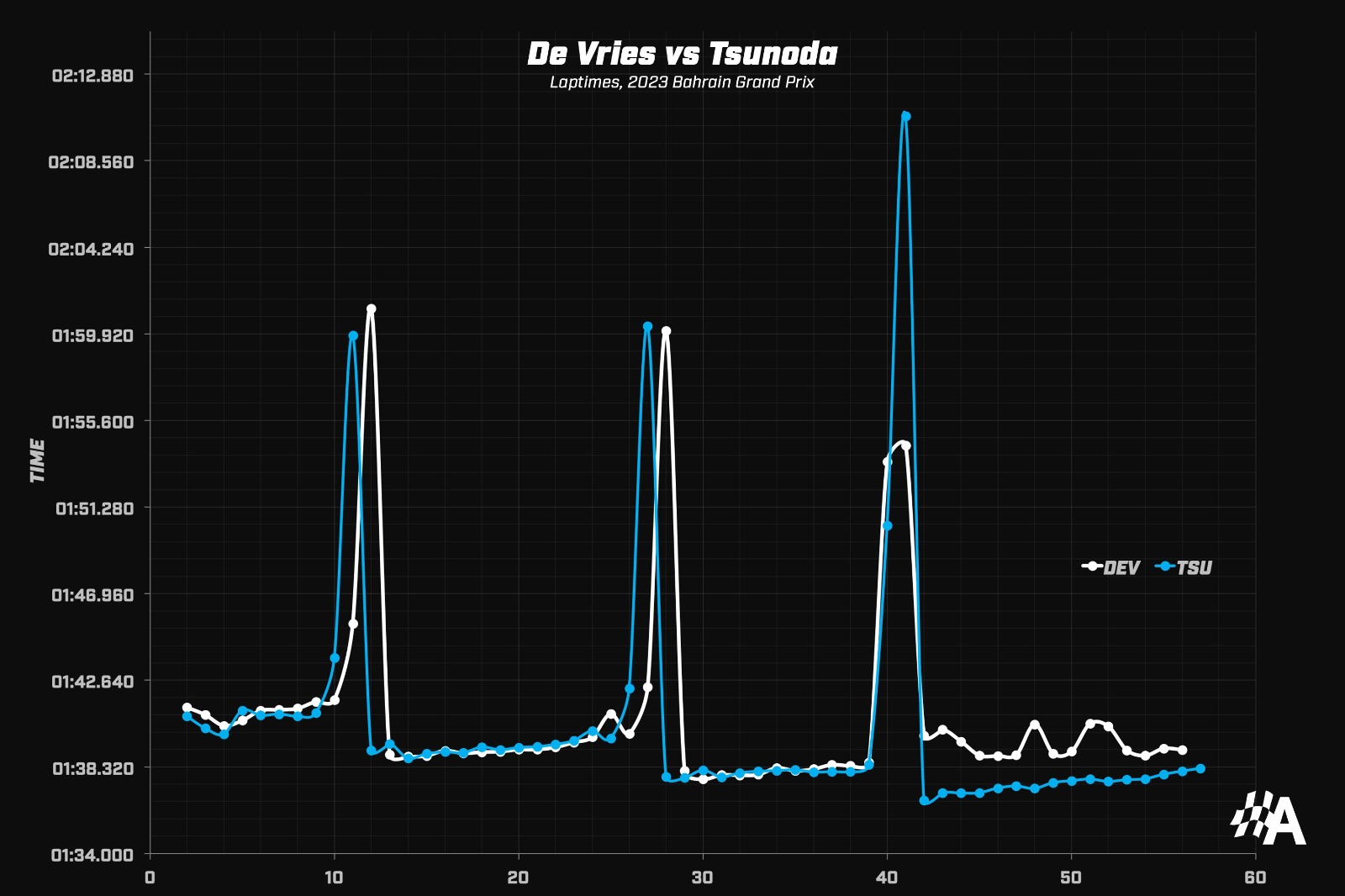
Outright pace between the two throughout the race prior to the lap 40 virtual safety car period was well matched, however, with the two comparable on times following the first stint owing to their common soft-hard-hard tyre strategies. Primarily, de Vries’s comparative lack of pace on the opening laps was due to missing the DRS train, while Tsunoda was in lockstep with the cars around him and benefitted from the reduced drag on the straights.
The two were on par over the next phases; removing in and outlaps, the two had 14 representative laps on the first set of hard tyres apiece and averaged 1m39.3s laptimes across that sample set, again putting them on effectively the same plane. With de Vries offset by a lap on Tsunoda, he has one less ‘racing’ lap on his second stint pre-VSC, but his 10 laps on that next set of hard tyres versus Tsunoda’s offered an average of 1m38.1s, Tsunoda marginally quicker with a 1m38.0s.
But here’s where the two diverged, as can be seen at the spike in Tsunoda’s trace. AlphaTauri made the decision to pit its third-year driver and keep de Vries out, the latter understandably frothing with irritation on the radio post-race that the team didn’t want to double-stack. Tsunoda, on lightly used softs, was one to three seconds a lap quicker than his team-mate persisting on aging hard boots during the course of that phase, which widens the gulf between them considerably.
Nonetheless, it was a solid performance from de Vries, and generally matching Tsunoda for pace should be the basis for future growth throughout the season. An analytical mind and a penchant for self-improvement has been part of the Frisian’s oeuvre for years, so that growth surely will not be in doubt if the team affords him the opportunity to do so.
Sargeant: Impressive tyre management skills

Williams’ head of vehicle performance praised Sargeant’s ability to manage the tyres in his first F1 race
Photo by: Williams
In the space of just over a year, Sargeant’s career has been completely turned around. One of Oscar Piastri’s key rivals in the 2020 F3 season, along with Sauber Academy driver Theo Pourchaire, Sargeant was forced into another year in the third-tier category owing to a lack of backing. There, he performed heroics with the tail-end Charouz team, and impressed Williams sufficiently for them to bring him into the fold as a junior driver.
Now, he’s driving for them in F1 off the back of finishing fourth in F2. Following that slow-burn period in F3, the American has been catapulted into the limelight as Nicholas Latifi’s replacement following the Canadian's three average-at-best years with the Grove squad.
Using the Bahrain Grand Prix figures, he’s a lot harder to compare with Albon, given that the two ran to very different FP2 programmes and offset race strategies. That said, there are certainly elements of similarity to mull over. Sargeant’s quickest lap in the night-time FP2 was just over three-tenths behind Albon, and the two diverged from here in the session; Albon was taking the hard tyre for a long-run exploration, while Sargeant was tasked with testing the limits of the soft on the abrasive Bahrain track surface.
They were less divided by qualifying, with each taking only two timed laps and their final runs split by a mere 0.191s. It proved to be the difference between Albon making Q2 and Sargeant missing out, but the Floridian already seems to be closer to level terms than Latifi.
Both Williams drivers made excellent starts, with Albon opening the gate to pass Tsunoda, Nico Hulkenberg and Zhou Guanyu on the opening lap and Sargeant subsequently following him through. Where the two largely differed was on the subsequent four laps, where Albon had a greater pace advantage which allowed him to break past Norris for 11th place. Sargeant, at this juncture, was more firmly entrenched in the DRS train behind the McLaren driver. Their laptimes converged towards the end of the stint, but Albon’s greater experience of F1’s opening stages and presumed tentativeness on Sargeant’s part likely made the difference here.
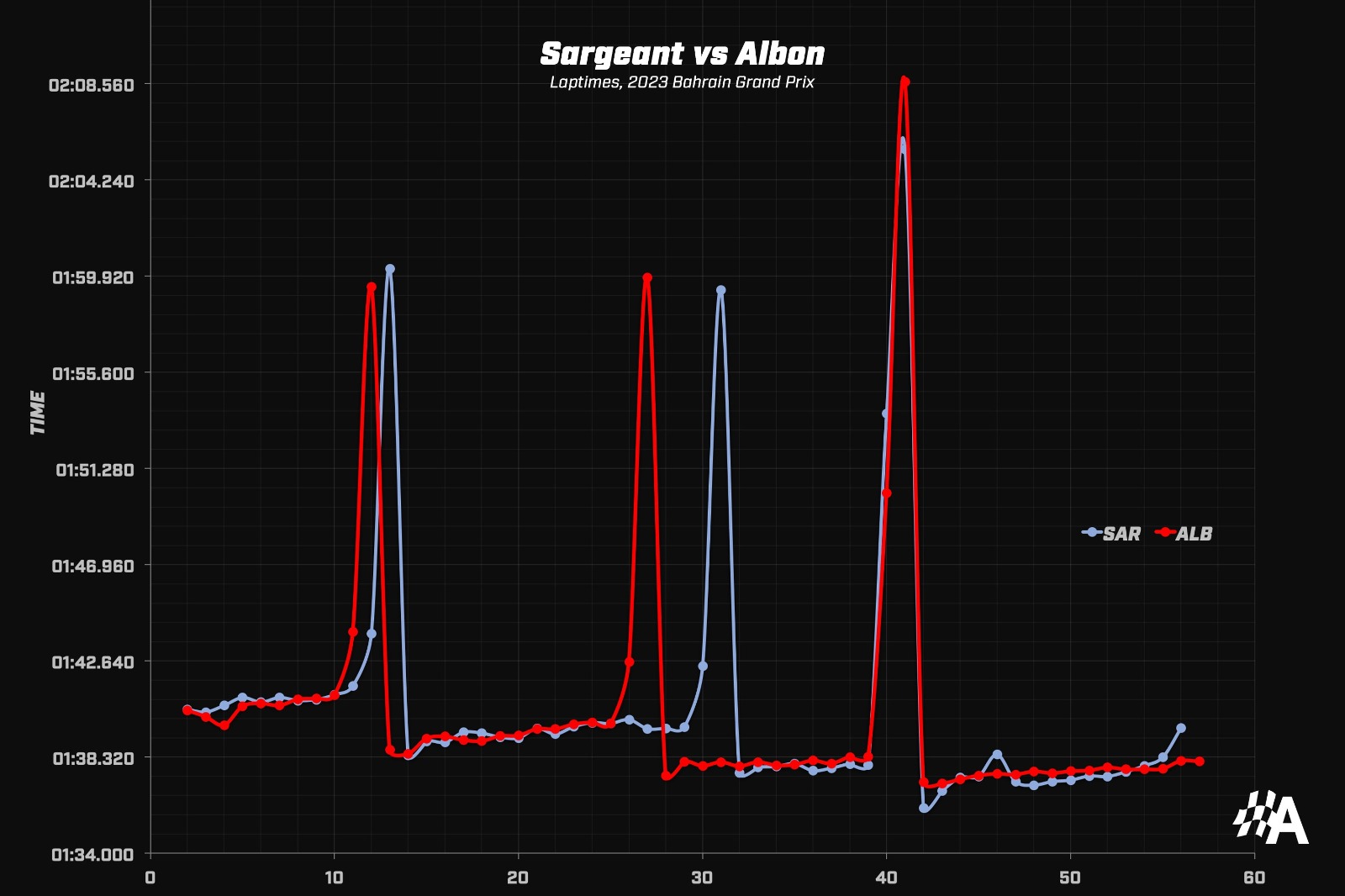
The second stint on soft tyres was largely neck-and-neck in the comparable laps, but Sargeant’s run was ultimately three laps longer. Regardless, the tail end of that stint was impressive and the rookie driver managed to remain in the same ballpark with his laptimes prior to a switch to hard tyres. Dave Robson, Williams’ head of vehicle performance, praised Sargeant’s ability to manage the tyres in his first F1 race that had perhaps been honed through trying to keep grip in the camembert structure of F2’s Pirelli rubber last season.
Albon had the longer stint on the hard tyre and, once Sargeant had made the switch, he was able to enjoy a greater burst of pace overall as the Anglo-Thai had to keep overall management into account. In that phase, Sargeant could afford to be a couple of tenths faster than his more experienced team-mate, before both cars collected softs again following the VSC period.
In comparing the curve of laptimes, Albon was the more consistent of the two, as Sargeant had the higher peaks but lower troughs. On average in that final stint, Sargeant was up by a tenth with a 1m37.562s versus Albon’s 1m37.627s, but it should be noted that the ex-Red Bull driver had to complete one further lap while trying to keep Tsunoda behind.
It was an assured performance from Sargeant on his first race outing in the FW45, and he looks to be a canny acquisition for Williams having been left largely on the scrapheap post-2020. 12th was a great return and, if the team can aim for more points over the course of the season, you can bet that Sargeant will be among them by the season’s end.
Piastri: A tough start to life with McLaren

Piastri endured a difficult maiden F1 race with McLaren
Photo by: Glenn Dunbar / Motorsport Images
As debut races go, Piastri’s night in Bahrain was one of a more nightmarish variety. He retired following his 13th lap, having pulled into the pits with a wiring harness issue. Once he’d come in and was kitted out with a new steering wheel, it flickered into life when the Australian went left-hand down with it but, turned straight on, it immediately switched off again.
The McLaren MCL60 is a tricky customer too. Having cited that the technical department decided on a change of course by September last year, technical chief James Key hoped that the new direction planned for Baku will offer more performance rewards. In the meantime, Piastri and Norris have to contend with a car that McLaren knows is not the optimal package.
That, allied to reliability issues, means that it’s hard to really compare the team-mates like-for-like. Their quickest FP2 laps were separated by about half a second, with their longer runs on the softs initially separated by 0.3-0.4s, both instances in Norris’ favour. But Piastri had been able to get that gap down over the course of the run, and was just over a tenth behind Norris at one point before the Briton did his final laps on the lesser-spotted medium compound.
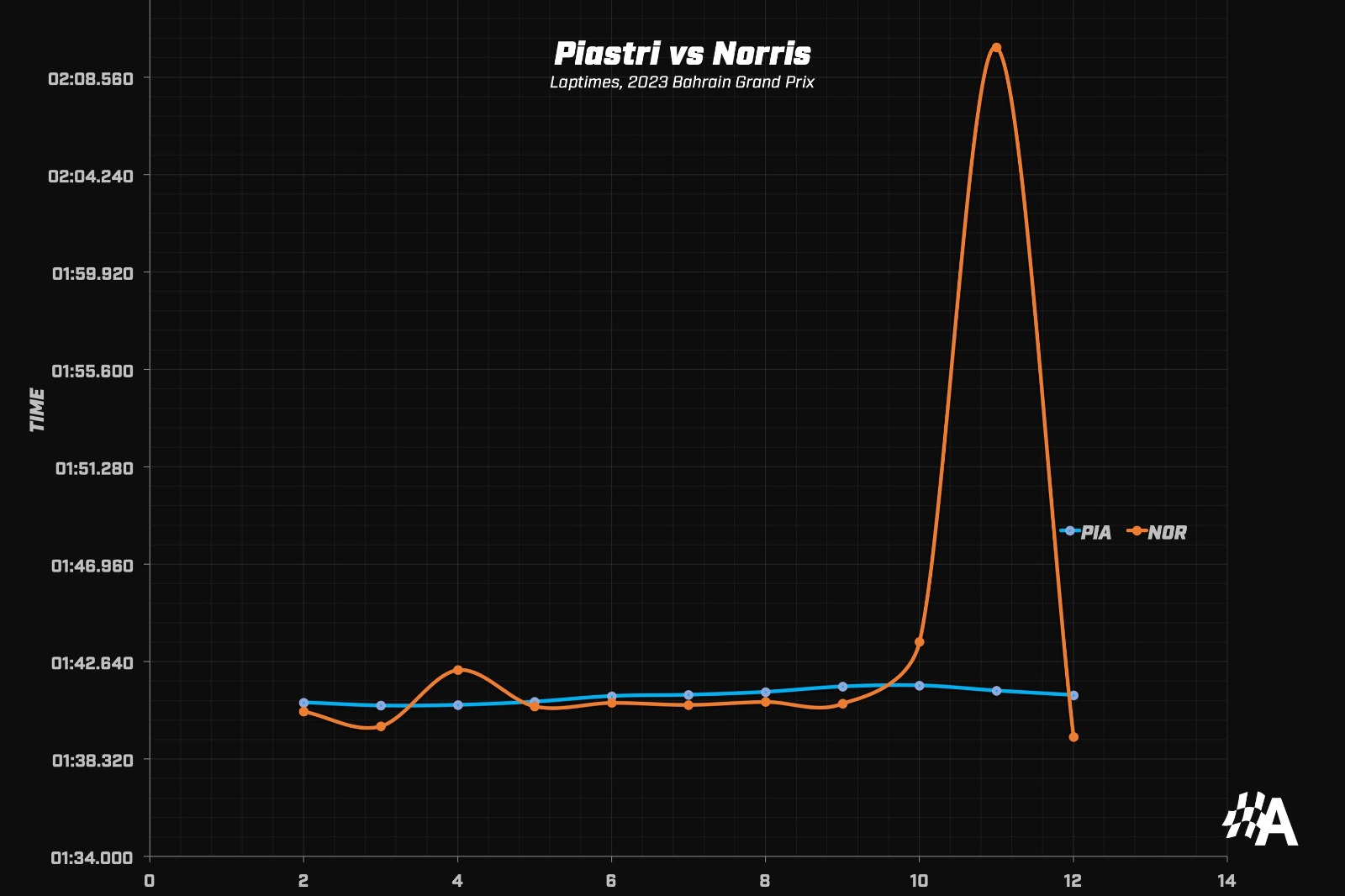
Piastri conceded that his qualifying was plagued by too many mistakes, and was 0.45s off Norris by the end of Q1 to bring his Saturday to an early close. And, in the little running he had in the race before the electronics went kaput, Norris was continually about 0.3-0.4s ahead. Whether the electrical issues cost Piastri time, as Norris was simultaneously dealing with his own pneumatic troubles, is currently unknown. Nonetheless, it proved to be a somewhat chastening debut for the young Melburnian.
Although we’re dealing with a sample set of one race here, there are promising glimmers from the 2023 newcomer brigade. Each one now has experience of a proper F1 race at a venue that, although forgiving, is a real test of tyre management abilities and endurance.
Perhaps we’ll revisit this thread later in the season, particularly as the data on hand will be much more expansive. But there’s nothing to say that any of this year’s rookies are out of their depth; on the contrary, they’ve proven their worth in getting to F1. The next step for them is to improve and develop their F1 chops, and their own team-mates will continue to be the benchmark in their growth as drivers.

Can any of 2023's rookie crop break out of the midfield?
Photo by: Mark Sutton / Motorsport Images


Hadjar set to make Red Bull return at Azerbaijan GP after injury recovery

F1 Monaco GP: Antonelli takes dominant win from Hamilton after chaotic finish

What we learned in Friday practice for the 2026 F1 Japanese GP

The scrutiny on Ferrari laid bare

How Verstappen tamed the City of Winds to deliver a warning shot to McLaren

Verstappen played his greatest hits at Monza, with 2023-esque dominance over McLaren

F1 Italian GP: Verstappen pips McLaren to surprise pole at Monza

Low-downforce wings headline F1 Italian GP updates

Verstappen responds to COTA boss and proposes drastic measures to tackle bumps

Supercars Gold Coast: Feeney converts Race 2 pole to win after Saturday defeat

MotoGP's final Australian GP at Phillip Island cancelled due to poor weather

Antonelli pole shows Mercedes is 'finally seeing the results' of car upgrades
Subscribe and access Autosport.com with your ad-blocker.
From Formula 1 to MotoGP we report straight from the paddock because we love our sport, just like you. In order to keep delivering our expert journalism, our website uses advertising. Still, we want to give you the opportunity to enjoy an ad-free and tracker-free website and to continue using your adblocker.


Top Comments