


How crucial marginal calls will decide the Red Bull vs Mercedes battle in F1 2021
The longer Red Bull can maintain a performance edge over Mercedes, the better the odds will be in the team’s favour against the defending world champions. But as the Bahrain Grand Prix showed, many more factors will be critical in the outcome of the 2021 Formula 1 World Championship

“We just have to make sure we have a faster car,” Max Verstappen tells Autosport.
In essence, the Red Bull driver is correct – having the fastest car on the grid will make any team the favourite to win races and titles. But things are rarely so simple in Formula 1.
The championship is only two weeks on from a thrilling season opener in Bahrain, but it was Mercedes and Lewis Hamilton that triumphed on the day, not Red Bull and Verstappen, who at least confirmed they have succeeded in producing the fastest car of 2021 so far. This advantage will be much harder to unpick than in a conventional campaign, with the development rules significantly more restricted. But that equally does not mean that Mercedes cannot tweak its package or improve performance in what it has currently got and the same is true of Red Bull.
PLUS: How the 'Great F1 Rake-Off' delivered a Bahrain GP showdown
What made the Bahrain race so spectacular was the tense way proceedings played out, plus Hamilton and Verstappen going wheel-to-wheel for the victory. And this is where the correctness of Verstappen’s comments on Red Bull simply needing to have the fastest car to succeed ends. He will undoubtedly be aware, but that element is just the biggest and most important factor that will likely decide the destination of the 2021 title, and there are other critical calls that may also make the difference.
Hamilton has proved that a slower package can still win the day – and the way things worked out in Bahrain immediately brought to mind the most recent F1 season that had a multi-team scrap for the title: 2012.
Back then, Fernando Alonso took an inferior Ferrari package to the brink of the title against what was then Sebastian Vettel’s Red Bull. It was a nail-bitingly close campaign, with Vettel eventually triumphing after the glut of different race winners characterised the first half of the season, before Red Bull fully understood the RB8’s complex rear bodywork tunnels that had frustrated the team earlier in the year. As well as the drama of Vettel’s collision early in the season finale, that campaign is so evocative in F1’s current era because of how Alonso hung on in contention, despite the RB8 being the best package come the end.
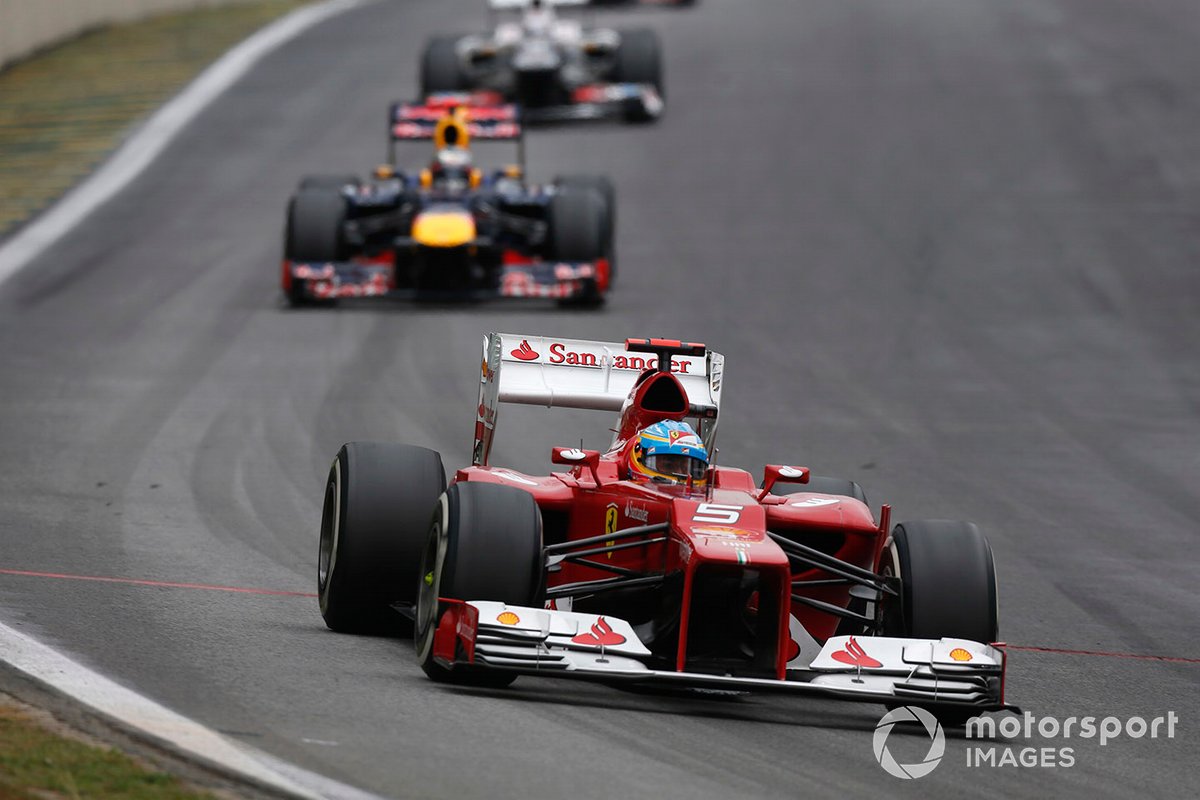
There has only been one race so far in 2021, but the Bahrain spectacle has raised hopes of a closely fought campaign, along the lines of what F1 enjoyed nine years ago. In the race’s aftermath, there was a sense stemming from within Mercedes that its 103rd F1 win since the start of 2014 really was a shock result.
“It was one of the most thrilling, nail-biting, sort of, chest-bursting experiences that I have ever had at a race track,” Mercedes’ technical director James Allison says of the final stages of the season opener.
But the seeds of that victory were sown much earlier in the weekend, with Mercedes having a crucial advantage in the extra set of hard tyres for both of its cars heading into the race.
Strategy calls and team operational attitude may rank below the fundamental factor of having a faster car, but they can still make or break races and championships
This was not a massive factor in the final result – “there isn’t, like, one of them is a no brainer, the other one is a completely moronic choice,” says Allison before adding: “It’s a matter of not taste, but each one has a slight advantage over the other in certain circumstances.”
PLUS: The calls that decided Hamilton and Verstappen's Bahrain battle
The hard tyre played a role in the outcome of the aggressive and successful strategy that Mercedes ultimately deployed – a two-stopper that required Hamilton to produce another tyre management masterclass on a long final stint to prevail. But that result still required Verstappen to make a critical, if minor, mistake during what would be the Dutchman’s sole passing attempt to regain the lead of the race.
Verstappen now knows he must be perfect if he is to succeed in a closely fought battle many F1 observers believe is a realistic possibility for the new season. But by already having the most critical advantage with the RB16B’s pace compared to the W12, this remains less critical to Red Bull. Mercedes knows that right now it needs to make the perfect strategy calls, have nothing go wrong operationally, and seize the fluctuating factor of fortune that live sport creates.

Lewis Hamilton, Mercedes W12, Max Verstappen, Red Bull Racing RB16B
Photo by: Mark Sutton / Motorsport Images
Had the second of those not going wrong for Valtteri Bottas during his second stop in the Bahrain race, then Hamilton would likely have been less reliant on the third – Verstappen’s snap-oversteer-induced late slip off the road.
Mercedes’ attempts to use the undercut power with both its cars would’ve forced Red Bull to at least consider lengthening Verstappen’s final stint on the hards, when Mercedes observed it had “shown some nervousness”, per Allison, about doing that earlier in the race. But a slight wheelgun misalignment on Bottas’s right-front made all of this immaterial.
Once Bottas was no longer a threat, Red Bull was free to keep Verstappen on its preferred approach to the two-stopper and that strategy would’ve succeeded had he made his late pass stick.
PLUS: How Verstappen's Bahrain mistake can only make him stronger
Red Bull has excellent form in making these close-run strategy calls work out in its favour. It thought it had an ace on its hands with Verstappen starting on mediums compared to Bottas’s softs in the 2020 season-opener, and it did succeed in beating Mercedes in the 70th Anniversary GP by having Verstappen start on the hards compared to the mediums on the Black Arrows. At that stage of last season, Mercedes’ pace advantage with the W11 remained massive.
Operationally, it’s worth remembering the incredible repair job Red Bull pulled off to fix Verstappen’s front suspension after he crashed before last season’s Hungarian GP. It’s a compelling example of the fine work this squad can produce under great pressure.

Race winner Max Verstappen, Red Bull Racing celebrates in Parc Ferme
Photo by: Andy Hone / Motorsport Images
That’s what is really going to make the difference if the 2021 season plays out as expected. Strategy calls and team operational attitude may rank below the fundamental factor of having a faster car, but they can still make or break races and championships.
Mercedes has already shown it can quickly pivot to deploying aggressive tactics as the chaser, while Red Bull demonstrated the inner confidence required to pull off strategies that require perfect execution to be successful.
These differing approaches made the Bahrain race a complex affair, and it could be just the start of many tight, technical battles to come this year.

Max Verstappen, Red Bull Racing RB16B, Lewis Hamilton, Mercedes W12
Photo by: Mark Sutton / Motorsport Images


Why Britain’s role in Formula 1 endured a troubled start

Why Bottas believes his F1 reserve driver role is the fastest route back to a race seat

Why Norris is now ready for his final exam

The key advantage for Bottas vs Perez in the 2026 F1 return race

Why Ferrari's management is under pressure after its bad start to F1 2025, not Hamilton or Leclerc

Why Red Bull can’t solve its second F1 car problem with a simple paint job

Hirakawa replaces Doohan at Alpine for Japanese GP FP1 outing

How Alonso and Bortoleto can be F1 rivals in a unique driver management deal

MotoGP Australian GP: Bezzecchi leads Aprilia 1-2-4-5 in Friday Practice

How Antonelli will manage the pressure as F1 coronation looms

Verstappen warns COTA bumps are “unacceptable” and “out of control”

Why Colapinto spoke out against abuse targeting his own F1 team
Subscribe and access Autosport.com with your ad-blocker.
From Formula 1 to MotoGP we report straight from the paddock because we love our sport, just like you. In order to keep delivering our expert journalism, our website uses advertising. Still, we want to give you the opportunity to enjoy an ad-free and tracker-free website and to continue using your adblocker.


Top Comments