


How a Mercedes "Achilles' heel" cost Verstappen in Hamilton's Interlagos masterclass
The qualifying exclusion which forced Lewis Hamilton to start from the back of the 2021 Interlagos sprint appeared to put Max Verstappen in the box seat for the Brazilian Grand Prix. But a common issue for Mercedes this year for once worked against the Red Bull ace, as Hamilton's rapid Mercedes stormed to a memorable comeback win

Max Verstappen’s drive to win the 2021 Mexico City Grand Prix was that of a champion. Lewis Hamilton’s drive to win the main race of Formula 1’s 2021 visit to Brazil was that of a seven-time world champion.
Consider the stakes with so few races remaining. Consider the pressure all that post-qualifying disqualification controversy created. Consider just how scintillating plenty of those sprint race and grand prix passes were. Hamilton lived up to his legend.
But he was almost forgotten about at the main Interlagos race’s start, where Verstappen reversed his sprint race loss from pole against Valtteri Bottas.
This time the Red Bull made the better getaway from the left-hand side of the grid, Verstappen quickly alongside Bottas as the Finn had an “average” launch with “a bit of clutch slip”. But he made a good fist of trying to wrestle back the lead that was fast departing his hands as the pair shot down through the Turn 1 apex.
He hung on around the outside, but Verstappen shoved him wide and half-off the track. The move was very firm, but fair – it just added to Bottas’s “nightmare” first lap as it meant he lost more momentum through the rest of the Senna Esses and soon had Sergio Perez alongside him as they raced down Interlagos’s shorter second straight. At Turn 4, later to be the scene of fireworks, Perez feigned to the outside and Bottas, carrying too much speed on the tighter inside line, slipped off into the runoff and fell behind.
Verstappen had a 1.3-second lead at the end of lap one of 71, with Hamilton an after-thought in the pack at this stage. He made up good ground at Turn 1, then riskily nipped by Pierre Gasly on the outside of Turns 6-7 to take seventh, before sealing sixth with a run around Sebastian Vettel’s outside ahead of Turn 1 on lap two. He passed the Ferrari pair at this point in successive laps, with Bottas ordered to let him by at the same spot at the start of tour five.

Verstappen dives past Bottas into Turn 1, as behind Norris slows after contact with Sainz caused him a puncture
Photo by: Zak Mauger / Motorsport Images
Hamilton was already behind just the Red Bulls, but the race was then interrupted by a safety car interjection – needed so debris strewn across the Esses in the aftermath of Yuki Tsunoda clattering Lance Stroll at the start of lap four could be cleared.
Once the pack had been led through the pitlane twice, the race resumed at the start of the 10th tour – Verstappen wisely leaving it until he was nearly back to the top grid hatchings, Perez keeping Hamilton at bay in his wake. The leader immediately restored his advantage to 1.3s, after which Perez began to come under considerable pressure from the marauding Mercedes.
Perez called for Verstappen to drop back to give him DRS assistance – something the Alpines had modest success with later in the race before Gasly got Fernando Alonso and Esteban Ocon in any case. But to do so would have exposed Verstappen to an increased undercut threat from either Mercedes car – the top four already quickly clear of the two following Ferraris.
Red Bull reacted to Mercedes’ stop immediately, pulling Verstappen in the next time by to go to the same compound and ward off Hamilton’s undercut threat. This wasn’t massively powerful, but couldn’t be ignored as Verstappen’s advantage was trimmed to 1.6s
On lap 18, after Perez had weaved a touch naughtily through the grid markings, Hamilton made a breath-taking move to his outside at Turn 1 – slamming the brakes on so late but still staying on the plunging left-hander and getting ahead. But the Mexican driver did not give up – using DRS into Turn 4 to seize second back again on the outside line and hand Verstappen a nifty advantage, his lead was increased to 3.8s by this thrilling racing.
The next time by, however, Hamilton’s near identical Turn 1 pass came off for good, as Perez was unable to stay as close through the Esses. Now then, the game everyone had really been waiting for arrived. Separated by stewarding decisions since the shambles in parc ferme on Friday afternoon, F1’s two leading drivers were set to resume battle.
After chasing Verstappen for six laps, Hamilton reported that his medium tyres were starting to slide. Up ahead, the Dutchman, who like everyone else bar Tsunoda (softs) had started on the same rubber, had just given similar feedback. And so, the opening exchanges of a tense strategy battle entered a race that, really, had it all.
Mercedes made the first aggressive call at the end of lap 26 – bringing Hamilton in to take the hards that none of the Black Arrows or Red Bull drivers had tried so far in the weekend, but which were expected to be the key race rubber given its added resilience in hot temperatures. These peaked at 53C track and 24C air on Sunday – up from the sprint event’s peaks of 36C track and 16C air – and set to be a key factor in what eventually played out in front of a vocal Sao Paulo crowd.
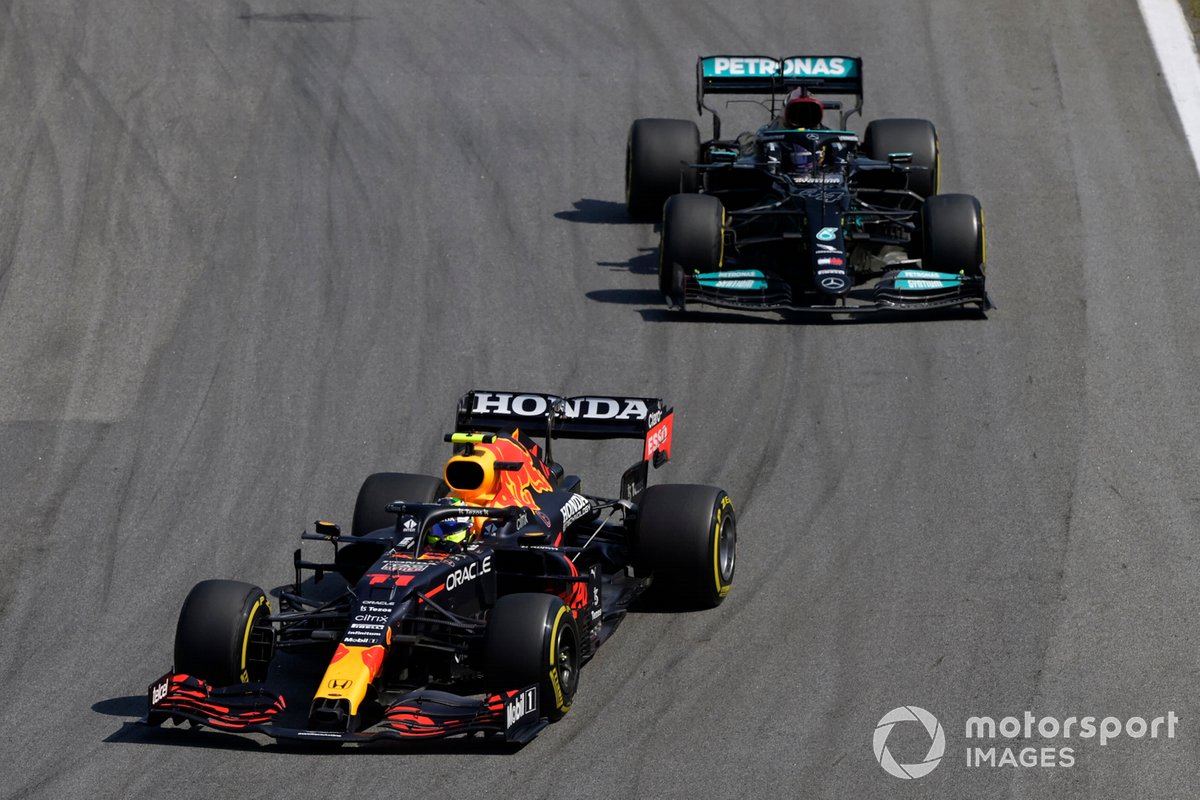
Once through on Perez, Hamilton quickly set after Verstappen and gained by pitting first for hards
Photo by: Mark Sutton / Motorsport Images
Red Bull reacted to Mercedes’ stop immediately, pulling Verstappen in the next time by to go to the same compound and ward off Hamilton’s undercut threat. This wasn’t massively powerful, but couldn’t be ignored – even with Hamilton losing a small amount of time catching McLaren’s Daniel Ricciardo and passing him in the background as Verstappen left the pit exit. He’d still done damage, though – Verstappen’s advantage trimmed to 1.6s.
At this stage the various charges were interrupted for a third time shortly after the leading pair’s first stops. The virtual safety car had already been activated once before to recover further debris dropped at Turn 1 not long after the safety car restart, needed because Mick Schumacher had slid into Kimi Raikkonen’s Alfa Romeo and ripped off his front wing.
But it was required again so debris on the pitstraight – from Stroll’s Aston Martin, still feeling the effects of the lunge that earned Tsunoda a 10s addition – could be removed on laps 30-31. Both periods were short and had little bearing on the race up front, other than allowing contenders and observers alike to catch their breath.
But the second VSC did have a particular bearing on the race behind Verstappen and Hamilton, as it allowed Bottas to take a cheap first stop for hards – two laps after Perez had come in from net third to take a green-flag service for the same rubber.
The VSC timing got Bottas ahead of the second Red Bull, although he fumed at not being allowed to try running long. Even after the race he felt his strategy “should have been [a] one-stop”. There was a chance, he believed, at “possibly being second”.
But the events played out as they did on the strategy front and now it was all about Hamilton’s chances of capping a remarkable recovery from the very back of the sprint race grid with his 101st F1 win – largely depending on what happened next on the tactical front.
The gap between the leaders at the finish line never got above 1.4s over the 12 laps that followed Verstappen’s first stop out-lap, but also did not come down past 0.9s as a brief stalemate played out.
Red Bull’s aggressive strategy call broke this – the team heeding Verstappen’s testy request to be the first driver to pit at the second round of stops and bringing him in for a second time at the end of the 40th tour.
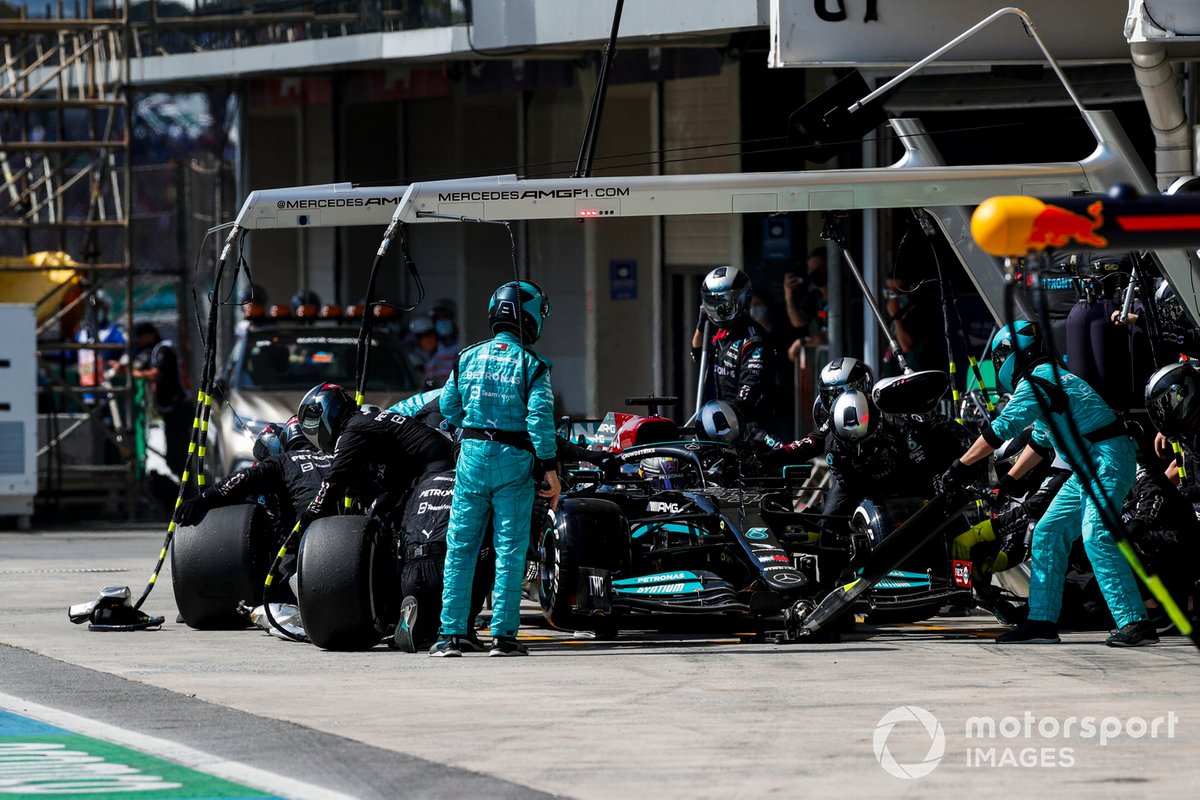
Mercedes waited three laps before pitting Hamilton after Verstappen's early second stop to build up a tyre offset
Photo by: Zak Mauger / Motorsport Images
Here, Mercedes had a decision to make, as its chief rival took a second set of new hards. “The option of going on an oddball strategy was discussed but wasn’t that attractive because there is doubt and if you get it wrong you cannot win the race,” said Mercedes’ director of trackside engineering Andrew Shovlin, amusingly rudely, of trying a one-stopper. “We felt we had the car pace to really attack if we could get a bit of a tyre offset.”
And so, Mercedes waited until the end of lap 43 before calling Hamilton in to mirror Verstappen’s strategy, albeit with a three-tour tyre life advantage. This left the world champion with 28 laps to catch and pass his fierce title rival.
A string of then fastest laps in the low 1m12s and a personal best 1m11.982s from the three tours on from his second out-lap eroded Verstappen’s advantage to 0.6s by the end of the 46th tour. This was the first time Hamilton had been in DRS range and that really put Verstappen under pressure. But a pass still looked tricky, as Hamilton said at this stage “he generally could match my pace”.
Just how tough passing would be became clear on lap 48. Hamilton jinked to towards Turn 1’s inside. It was never going to result in a pass, but it forced Verstappen to react and head slightly off the racing line. This compromised his run down the rest of the Esses and onto the second straight, where Hamilton closed in with DRS and edged ahead as they braked for the fast, downhill left – the only spot on the track where track limits were being policed by the FIA.
"I think he was running out of road, so I obviously had to avoid [him] to go out of road – but I mean, I didn’t think too much of it. Obviously, I’ll have to watch the replay, but it’s hard battling and wouldn’t expect anything less really" Lewis Hamilton
But Verstappen wasn’t done. He steamed back up on the inside line and thrust his nose to the apex to reclaim the lead – except in doing so his line took him wide on the exit and into the runoff, with Hamilton also off the road behind him.
This was the race’s controversial moment, as the onboard replays did not show Verstappen’s steering movement and race director Michael Masi, who noted the incident but did not refer it to the stewards, saying “we have the overall ‘let them race principles’, and looking at it all, with all of the angles that we had available, that philosophy was adopted”. Perhaps critically, in this officiating call, Masi was only able to access the front-facing camera images from Verstappen’s car once the race had ended.
“We both, of course, tried to be ahead into the corner,” Verstappen explained when Autosport asked about the move in the post-race press conference. “And so, I braked a bit later to try and keep the position and the tyres were already a bit worn – so I was really on the edge of grip.

The two title rivals went off at Turn 4 as Verstappen robustly defended the inside and ran wide, but both avoided contact and continued
Photo by: Charles Coates / Motorsport Images
“That’s why I think I was already not fully on the apex, so then it’s a safer way of just running a bit wide there. In a way I was of course happy that the stewards decided that we could just keep on racing because I think the racing in general was really good.”
Hamilton’s assessment was diplomatic: “I think I was ahead initially, and I think he held his ground and we both ran out of road. Well, I think he was running out of road, so I obviously had to avoid [him] to go out of road – but I mean, I didn’t think too much of it. Obviously, I’ll have to watch the replay, but it’s hard battling and wouldn’t expect anything less really. We didn’t touch wheels, which is good.”
Hamilton had another look at the same spot 10 laps later, but Verstappen’s better line through the preceding corners onto the straight and weaving repeatedly down it, which earned him black/white flag warning from Masi, meant he had enough momentum to stay ahead by the Turn 4 braking zone. Not so, on lap 59.
Here, Hamilton again moved late to Turn 1’s inside and again Verstappen responded. The sequence played out in near identical fashion as 11 laps earlier, except this time Hamilton swept ahead once he got just enough in front to seal the lead by the braking zone.
“I saw I had that experience and just made sure that I didn’t make that mistake again,” Hamilton said of his successful third passing attempt. “I was adamant and determined to get back into that position. It was fine. This is what a world championship battle should look like.”
Verstappen’s second set of hards were crying enough – something he’d been feeling “two laps before” Hamilton’s winning move was made, as he was “really starting to struggle on traction”. That meant Hamilton romped clear to win by 10.5s, with Bottas unable to catch Verstappen despite being urged on by Mercedes team boss Toto Wolff.
Inevitably, there were late fastest-lap shenanigans, with Red Bull smartly pitting Perez on lap 69 as he had more than 30s in hand over Charles Leclerc and the closely following Carlos Sainz Jr. Armed with softs, Perez pumped in a 1m11.010s on the final lap to deprive Hamilton of an extra point – his best lap stemming back to his early fliers just after his second stop.
“[That was] one of the most challenging, if not the most challenging [event] – with the things that we’ve faced during the weekend,” Hamilton reflected afterwards. “But in terms of driving, I feel like it’s maybe been my best…”

Once clear of Verstappen, Hamilton comfortably pulled away to his 101st win
Photo by: Andy Hone / Motorsport Images
What added to how stunning this result was, was how Red Bull had entered the weekend as the firm favourite.
It had won convincingly here in 2019 and had given Mercedes a drubbing in last week’s Mexico race. Plus, Hamilton had feared the hotter Sunday temperatures “potentially would be an Achilles’ heel for us” – as the W12 continues to struggle with rear end stability. This had been good in the cooler sprint race, where Hamilton’s excellent traction out of Turn 12, the track’s last real corner heading uphill to the line, was a key factor in his succession of passes. Plus, Red Bull has typically gone better in hot 2021 races, displaying better tyre degradation levels.
But that all got upturned last Sunday. There can be no doubt that Hamilton’s fifth internal combustion unit gave him a performance boost. The freshness will have helped on the power front, but there is a suspicion Mercedes could run it in a higher mode because there are so few races remaining, with the part’s high wear rate as its life goes on a key reason why Mercedes has churned through so many this year.
"I had to get my time somewhere to try and match Lewis and that was of course through the middle sector where the corners mainly are. That meant that I had to use my tyres a bit more and at one point I just ran out of tyres to try and defend" Max Verstappen
The engine boost, allied with the W12’s inherent, low-rake drag advantage over the high-rake, downforce-laden RB16B meant Red Bull team boss Christian Horner felt his rival could have “Monaco rear wing on here”, which is perhaps what Hamilton referred to when he revealed “I chose to go a direction [on car arrangement] this weekend” which “worked really well” – although Mercedes remained tight-lipped over his explanation afterwards.
Whatever the combination that made the W12 the package to beat last weekend, it meant Hamilton could hurt Verstappen where Red Bull was strongest at Interlagos.
That was the second sector, where “there are not that many corners but high degradation”, per Verstappen – referring in particular to the rapid, double right of Turns 6-7 at the end of the second straight, and the downhill left-hand Turn 11 swoop at the end of the second sector. At these points, all the drivers had to take care not to stress their rubber.
“Straightline performance is very important on a track like this, and of course the deg is important [too],” explained Verstappen, as unflappable as ever in defeat. “I had to get my time somewhere to try and match Lewis and that was of course through the middle sector where the corners mainly are. That meant that I had to use my tyres a bit more and at one point I just ran out of tyres to try and defend. But that’s how it goes.”
How it went at Interlagos was thrilling, fascinating and inspiring – much like the 2021 championship overall. A race for the ages in a season that matches.

Verstappen had to work his tyres harder in the middle sector to maintain a gap onto the straight, as Hamilton bided his time
Photo by: Mark Sutton / Motorsport Images


Why Britain’s role in Formula 1 endured a troubled start

Why Bottas believes his F1 reserve driver role is the fastest route back to a race seat

Why Norris is now ready for his final exam

The key advantage for Bottas vs Perez in the 2026 F1 return race

Why Ferrari's management is under pressure after its bad start to F1 2025, not Hamilton or Leclerc

Why Red Bull can’t solve its second F1 car problem with a simple paint job

Hirakawa replaces Doohan at Alpine for Japanese GP FP1 outing

How Alonso and Bortoleto can be F1 rivals in a unique driver management deal

BTCC Brands Hatch GP: Moffat leads throughout to beat Ingram in qualifying race

F1 Singapore GP: Verstappen continues recent dominance with pole

Loeb testing for Project Rally One ahead of WRC debut

F1 Singapore GP live commentary and updates - Verstappen on pole
Subscribe and access Autosport.com with your ad-blocker.
From Formula 1 to MotoGP we report straight from the paddock because we love our sport, just like you. In order to keep delivering our expert journalism, our website uses advertising. Still, we want to give you the opportunity to enjoy an ad-free and tracker-free website and to continue using your adblocker.


Top Comments