


Finding the greatest number two drivers in F1 history
In every Formula 1 championship-winning team, one driver has to play second fiddle to their team-mate in the final ranking. While some drivers have been thrashed and others have competed for equal number one status, several have fallen into the 'happy' medium that qualifies them for consideration in this debate

What makes a great number two driver in Formula 1? And which racers over the years have best fulfilled that role?
No driver sets out to be a number two but that doesn’t mean it’s not an important job. A good second driver can make the difference between a constructors’ championship – and millions of pounds – being won or lost, or even the outcome of a drivers’ title. Valtteri Bottas outscoring Sergio Perez was key to Mercedes winning the 2021 constructors’ crown, despite the pace of Red Bull’s RB16B and Max Verstappen’s success.
In recent times, Mercedes and Lewis Hamilton have commended the teamwork and harmony Bottas brought to the benchmark F1 team, while there was much discussion about the lack of Red Bull’s strategic options as it struggled to find a replacement for Daniel Ricciardo alongside Verstappen.
An ideal number two also needs to be fast enough to keep the team leader on their toes, assist in developing the car, and be able to pick up the pieces if something happens to the number one, as Perez did in the 2021 Azerbaijan Grand Prix.
A look at F1 history can be enlightening on what teams need from a number two and Autosport has crunched some numbers. We’ve looked at the percentage the second driver has scored of the number one’s championship tally (so, if the lead driver scored 100 points and the second driver scored 70, that’s 70%), and the percentage each driver contributed to the team’s constructors’ points total.
We’ve focused on the championship-winning and contending teams because it stands to reasons the best drivers (number ones or twos) end up in the leading squads and because there is more data – drivers in less-competitive teams don’t always score points even if they are performing brilliantly (think George Russell at Williams).

Bottas outscored Perez in 2021, helping Mercedes to beat Red Bull to the constructors' championship title
Photo by: Mark Sutton / Motorsport Images
The drivers on this list are therefore not the only potential drivers for the ‘best number two’ accolade, but they are probably the strongest.
Modern era: 1997-2021
| Year | Champion | Team-mate | Percentage | Constructors' share |
| 2021 | Verstappen | Perez | 48 | 68/32 (lost constructors’ title) |
| 2020 | Hamilton | Bottas | 64 | 61/39 |
| 2019 | Hamilton | Bottas | 79 | 56/44 |
| 2018 | Hamilton | Bottas | 61 | 62/38 |
| 2017 | Hamilton | Bottas | 84 | 54/46 |
| 2016 | Rosberg | Hamilton | 99 | 50/50 |
| 2015 | Hamilton | Rosberg | 85 | 54/46 |
| 2014 | Hamilton | Rosberg | 83 | 55/45 |
| 2013 | Vettel | Webber | 50 | 67/33 |
| 2012 | Vettel | Webber | 64 | 61/39 |
| 2011 | Vettel | Webber | 66 | 60/40 |
| 2010 | Vettel | Webber | 95 | 51/49 |
| 2009 | Button | Barrichello | 81 | 55/45 |
| 2008 | Hamilton | Kovalainen | 54 | 65/35 (lost constructors’ title) |
| 2007 | Raikkonen | Massa | 85 | 54/46 |
| 2006 | Alonso | Fisichella | 54 | 65/35 |
| 2005 | Alonso | Fisichella | 44 | 70/30 |
| 2004 | Schumacher | Barrichello | 77 | 56/44 |
| 2003 | Schumacher | Barrichello | 70 | 59/41 |
| 2002 | Schumacher | Barrichello | 53 | 65/35 |
| 2001 | Schumacher | Barrichello | 46 | 69/31 |
| 2000 | Schumacher | Barrichello | 57 | 64/36 |
| 1999 | Hakkinen | Coulthard | 63 | 61/39 (lost constructors’ title) |
| 1998 | Hakkinen | Coulthard | 56 | 64/36 |
| 1997 | Villeneuve | Frentzen | 52 | 66/34 |
The first thing to note is that the second drivers in each team can largely be grouped. It seems that if a driver scores 80% or more of their team-mate’s total, they can be considered an equal number one, or at least a driver who gives the team a headache, a ‘number 1.5’.
This might on the face of it provide the team with its best chance, but there are plenty of examples (including Nigel Mansell and Nelson Piquet at Williams, Ayrton Senna and Alain Prost at McLaren) where such a rivalry created a toxic atmosphere that ultimately damaged the team. And, for the purposes of this debate, no half of the equation can be considered the ‘number two’.
At the other end of the spectrum, a driver scoring less than 55% of their team-mate’s total could be regarded as not pulling their weight. In 2008 Heikki Kovalainen scored 54% of Hamilton’s total and contributed just 35% of McLaren’s points. While Hamilton took the drivers’ crown, McLaren lost the constructors’ title to Ferrari, which had a 56/44 split across Felipe Massa and Kimi Raikkonen.

Kovalainen scored only 54% of champion Hamilton’s total and contributed just 35% of McLaren’s points in 2008 as Ferrari scooped the constructors' title
Photo by: Sutton Images
Until 2021 that was the last time that the constructors’ crown was taken by a team that didn’t also win the drivers’ crown. Bottas scored 58% of Hamilton’s total and contributed 37% of Mercedes’ 2021 score, his lowest amounts in his five years with the team, but it was still better than the figures of 48% and 32% share Perez managed for Red Bull. Perez certainly had his moments, most memorably with his wheel-to-wheel dice with Hamilton in the Abu Dhabi finale, but Bottas was the stronger supporting driver when it came to the 2021 title fight as a whole.
Renault narrowly managed to take the constructors’ title in 2005 and 2006 despite Giancarlo Fisichella only scoring 44% and 54% respectively of Fernando Alonso’s tally. It would surely have lost the 2005 championship had McLaren had slightly better reliability.
So the ‘golden range’ a number two needs to be in seems to be around 55-79% of their team-mate’s tally. Hitting that mark indicates a good back-up score without truly threatening the team leader. Contributing 36-44% of the team’s total (assuming it’s a two-driver team) appears ideal in a defined number one/number two scenario.
Of course, that doesn’t always mean a title will always be forthcoming – other factors such as the competitiveness of the opposition will also affect the outcome. But the figures stand up pretty well over the years and four drivers stand out.
Across their four title-winning campaigns together, Webber averaged 69% of Vettel’s total, or 72% if their first season together in 2009 is included. Webber is hurt slightly in this debate by the fact his contribution reduced as the years went by
Across McLaren’s successful 1998-99 seasons, David Coulthard averaged 60% of Mika Hakkinen’s score. Across their six seasons together, which included two seasons (1997 and 2001) when Coulthard outscored the Finn, DC scored 82% of Hakkinen’s total. That’s partly due to the 2001 season, when an unfortunate and less-motivated Hakkinen was soundly beaten by Coulthard, but it pushes DC into the ‘number 1.5’ zone.
Coulthard’s old F3 sparring partner Rubens Barrichello scored 61% of Michael Schumacher’s tally across 2000-04, when Ferrari won five title doubles, and matched that in 2005, their final year together. He scored 81% of Jenson Button’s total during the Briton’s title-winning year at Brawn, so in the six seasons in which Barrichello was team-mate to that year’s world champion the Brazilian managed 64% of his colleague’s tallies.
Mark Webber challenged for the 2010 world title but thereafter played second fiddle to Sebastian Vettel at Red Bull. Across their four title-winning campaigns together, Webber averaged 69% of Vettel’s total, or 72% if their first season together in 2009 is included.
Webber is hurt slightly in this debate by the fact his contribution reduced as the years went by, allied to the tensions with team-mate Vettel, even if he was usually the victim in such circumstances. He also failed to win a GP in 2013, a season in which Vettel won the title with 13 victories, worse even than Bottas’s 11-0 loss to Hamilton in the longer 2018 campaign.

Webber and Vettel were evenly-matched in 2010, but the Australian's percentages relative to his team-mate fell away
Photo by: Steve Etherington / Motorsport Images
Between 2017 and 2021, Bottas averaged 69% of Hamilton’s score, including one season (interestingly, his first) in which he made it into the ‘1.5’ region. His falling percentages over the past three years might have worked against Bottas when it came to Mercedes boss Toto Wolff’s decision as to whether to keep the Finn or sign Russell for 2022. But the stats show that, despite periods of poor form and wet-weather struggles, Bottas was a very strong number two for Hamilton, whether or not he enjoyed the “wingman” tag.
The same approach also highlights Red Bull’s troubles. In 2017 Ricciardo actually beat rising star Verstappen in the final points table and still scored 68% of the Dutchman’s total in 2018. Pierre Gasly managed 35% across the first 12 races in 2019, while Alex Albon scored 58% of Verstappen’s tally across his season and a half. As previously mentioned, Perez – who has the chance of improving in 2022 – currently sits in between on 48%…
F1’s changing rules and philosophy: 1979-96
| Year | Champion | Team-mate | Percentage | Constructors' share |
| 1996 | Hill | Villeneuve | 80 | 55/45 |
| 1995 | Schumacher | Herbert | 44 | 67/33 |
| 1994 | Schumacher | Verstappen | 11 | 89/10/1* (lost constructors’ title) |
| 1993 | Prost | Hill | 70 | 59/41 |
| 1992 | Mansell | Patrese | 52 | 66/34 |
| 1991 | Senna | Berger | 45 | 69/31 |
| 1990 | Senna | Berger | 55 | 64/36 |
| 1989 | Prost | Senna | 79 | 57/43 |
| 1988 | Senna | Prost | 97 | 47/53** |
| 1987 | Piquet | Mansell | 84 | 55/45 |
| 1986 | Prost | Rosberg | 31 | 77/23 (lost constructors’ title) |
| 1985 | Prost | Lauda | 19 | 84/16 |
| 1984 | Lauda | Prost | 99 | 50/50 |
| 1983 | Piquet | Patrese | 22 | 82/18 (lost constructors’ title) |
| 1982 | Rosberg | Daly | 18 | 76/14/10*** (lost constructors’ title) |
| 1981 | Piquet | Rebaque | 22 | 82/18 (lost constructors’ title) |
| 1980 | Jones | Reutemann | 63 | 59/41 |
| 1979 | Scheckter | Villeneuve | 92 | 53/47 |
* JJ Lehto also scored a point
** Constructors’ title did not employ the same dropped-scores rule as the drivers’ contest, so Prost contributed more to McLaren’s total than 1988 champion Senna
*** Reutemann also scored points for Williams before retiring from F1
Prior to 1979 the waters are muddied by a significantly different points system. A constructor only scored points from its best finisher in each GP. Lotus pair Mario Andretti and Ronnie Peterson scored four 1-2s during 1978 but each time the team only scored nine points, the reward for victory at the time. Dropped scores – putting emphasis on wins and podiums rather than points accumulation – also had an impact.
This mean teams’ requirements of a number two were subtly different. Although poorer car reliability meant you’d still ideally have a good number two, teams could get away with focusing on one car/driver. For example, had all scores from both drivers counted, BRM would have won the constructors’ title in 1965 with its balanced line-up of experienced Graham Hill and star rookie Jackie Stewart. As it was, Lotus won the title, with all its points contributed by that year’s world champion, Jim Clark.

Rosberg (right) managed only 31% of Prost's points tally in 1986, a year when Williams' pair was too evenly-matched for its own good
Photo by: Motorsport Images
That change in the early 1980s, along with the unreliability of the new turbocharged engine technology, perhaps helps to explain why there were several championships in which the drivers’ champion did not race for the team that won the constructors’ title.
Williams took 1981 laurels as Hector Rebaque failed to back up Piquet enough at Brabham, scoring just 22% of the champion’s total. The reverse happened the following year, Derek Daly only scoring 18% of title-winning Williams team-mate Keke Rosberg’s tally, while Ferrari won the constructors’ championship with four different drivers.
Ferrari’s Rene Arnoux and Patrick Tambay were closely matched in 1983, resulting in a 55/45 splint, much better than the 82/18 split at Brabham, where Riccardo Patrese scored just 22% of champion Piquet’s total.
After that, leading teams generally became more balanced, though Williams was too even in 1986. It won the constructors’ title by miles, but the share between Mansell and Piquet was 51/49, enough for Prost to steal the drivers’ crown as he scored a whopping 77% of McLaren’s points.
Reliance on number ones: 1950-78
| Year | Champion | Team-mate | Percentage |
| 1978 | Andretti | Peterson | 80 |
| 1977 | Lauda | Reutemann | 58 |
| 1976 | Hunt | Mass | 28 (lost constructors’ title) |
| 1975 | Lauda | Regazzoni | 39 |
| 1974 | Fittipaldi | Hulme | 36 |
| 1973 | Stewart | Cevert | 66 (lost constructors’ title) |
| 1972 | Fittipaldi | Walker | 0 |
| 1971 | Stewart | Cevert | 42 |
| 1970 | Rindt | Miles | 4 |
| 1969 | Stewart | Beltoise | 33 |
| 1968 | Hill | Oliver | 13 |
| 1967 | Hulme | Brabham | 90 |
| 1966 | Brabham | Hulme | 43 |
| 1965 | Clark | Spence | 19 |
| 1964 | Surtees | Bandini | 58 |
| 1963 | Clark | Taylor | 2 |
| 1962 | Hill | Ginther | 24 |
| 1961 | Hill | von Trips | 97 |
| 1960 | Brabham | McLaren | 79 |
| 1959 | Brabham | McLaren | 53 |
| 1958 | Hawthorn | Collins | 33 (lost constructors’ title) |
| 1957 | Fangio | Schell | 18 |
| 1956 | Fangio | Collins | 83 |
| 1955 | Fangio | Moss | 58 |
| 1954 | Fangio | Kling | 29 |
| 1953 | Ascari | Farina | 75 |
| 1952 | Ascari | Farina | 67 |
| 1951 | Fangio | Farina | 61 |
| 1950 | Farina | Fangio | 90 |

Dave Walker didn't score a single point alongside 1972 title-winner Fittipaldi at Lotus
Photo by: Motorsport Images
Perhaps unsurprisingly, few drivers from the early days of the world championship register using our above percentages. Stirling Moss scored 58% of Juan Manuel Fangio’s total at Mercedes in 1955, but that was a very specific dynamic – Moss learning from the Master (while also outpacing him in sportscar events) – and in all other seasons Moss was invariably team leader, so he does not qualify for number two status in this debate.
Similarly, inaugural F1 world champion Giuseppe Farina was in the ‘golden zone’ across 1951-53 (alongside Fangio at Alfa Romeo and then Alberto Ascari at Ferrari), but under different circumstances and with limited opposition from other teams. He was also arguably past his best and was a candidate for team leadership earlier in his career.
Peter Collins famously gave up his car for Ferrari team leader Fangio in the 1956 Italian GP, helping the Argentinian secure his fourth title. That’s a very different kind of number two support and was soon outlawed. Collins scored 83% of Fangio’s total (76% if dropped scores are ignored) in 1956.
PLUS: How Britain's lost Ferrari star epitomised a bygone F1 era
In all three cases there was also no constructors’ crown to win, so what we would now consider a significant part of the job was missing. It was also a period when leading teams often ran more than two cars, or sometimes had different drivers in second or third entries from event to event.
Cevert is often regarded as a lost world champion, having been killed in practice for the 1973 United States GP just as team leader Stewart was about to retire. Cevert scored six second places, three to Stewart, and managed 66% of the Scot’s total that year
Collins was only on 47% of team-mate Mike Hawthorn’s score when he was killed in the 1958 German GP and Ferrari ended up losing the inaugural constructors’ crown to Vanwall, with the Moss-Tony Brooks line-up arguably stronger than Hawthorn-Collins.
Perhaps more interesting are the cases of Brooks, Francois Cevert and Peterson. Brooks scored 59% of Vanwall team leader Moss’s tally in 1958, despite missing the first round that the team skipped while Moss won on an outing with the privateer Rob Walker outfit. Ignoring that race would boost Brooks to 73%.
Brooks picked up the pieces three times when Moss’s car broke and could have prevented Ferrari’s Hawthorn taking the 1958 drivers’ crown had his car not failed in the Moroccan GP finale. It’s hard not to see anything other than Brooks being the perfect number two – having to put up with Moss taking the best chassis/engine combinations as he saw it and precluding Brooks from really honing his own machines – across 1957-58. When he joined Ferrari in 1959 he was the clear team leader and it is probably fair to say the under-rated Briton was in reality at least a ‘1.5’ driver.

Brooks was an excellent support act to Moss
Photo by: Motorsport Images
Cevert is often regarded as a lost world champion, having been killed in practice for the 1973 United States GP just as team leader Stewart was about to retire. Cevert scored six second places, three to Stewart, and managed 66% of the Scot’s total that year.
And yet Tyrrell lost the constructors’ title to Lotus, where Peterson scored 95% of Emerson Fittipaldi’s total and actually won four GPs to the Brazilian’s three. This was something of a double-edged sword, the split Lotus effort helping Stewart to defeat both. In fairness to Cevert, the Lotus was the faster and easier car, Stewart’s success also being down to perhaps the greatest campaign by one of F1's finest ever drivers.
Peterson’s sheer pace makes casting him as a number two seem harsh – and he had periods leading both March and Lotus – but he has to get a mention as Lotus scored two constructors’ titles and a drivers’ title (Andretti’s in 1978) while he was there.
Ultimately, the Superswede doesn’t really fit the mould for a number two. Aside from his pace – quicker than Fittipaldi and in some eyes faster than Andretti – he was famously not a good test driver or helpful with set-up. He did help Andretti in 1978, but Chapman’s reluctance to get Peterson to assist Fittipaldi (particularly at Monza in 1973) contributed both to Stewart snatching the title and Emerson making his successful switch to McLaren.
PLUS: Ronnie Peterson's greatest drives
And the winner is…
Choosing a ‘winner’ for this contest is fraught with difficulty because it’s a competition no driver sets out to win. And because many drivers inevitably find themselves in number one and number two slots at different times, depending on where they are in their careers, which teams they are at and, of course, who is driving the other car.
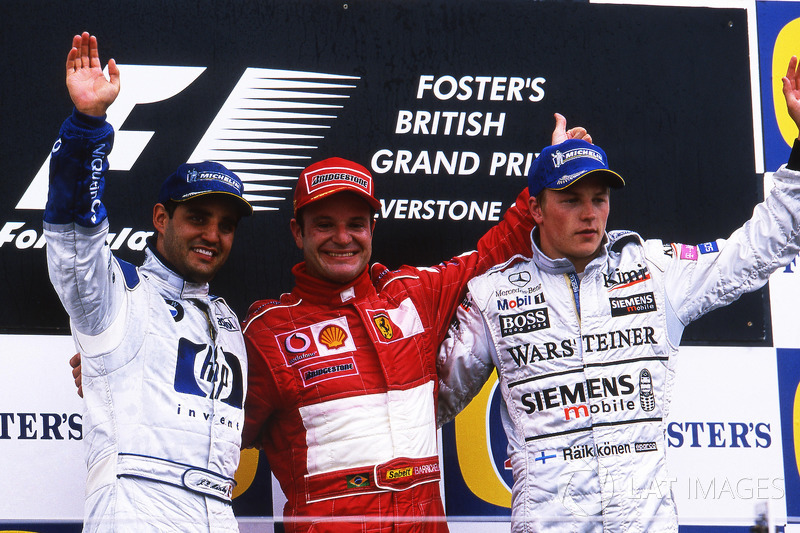
The value of a good number two, however, is clear. Given their contribution alongside two of F1’s greats and the success their teams scored over several seasons, Bottas and Barrichello have to be among the very top names in this debate.
Barrichello was a highly-dependable number two in the years of Ferrari domination in the early 2000s
Photo by: Sutton Images


Top 10 F1 results changed by backmarkers – the passes

Top 10 F1 results changed by backmarkers – the clashes

Stars, cars and highlights from the 2026 Goodwood Revival

The Egal has landed – again

Autosport magazine: Antonelli and a Can-Am celebration

Top 10 Can-Am drivers

Top 10 Can-Am cars

Top 10 greatest F1 qualifiers

F1 Bahrain GP in Malaysia: Verstappen dominates for first pole of 2026 from Hamilton

MotoGP Japanese GP: Marquez defeats Moreira for sprint victory

F1 Bahrain GP in Malaysia: Antonelli recovers from tough Friday to top FP3

F1 Bahrain GP in Malaysia: Verstappen dominates for pole from Hamilton
Subscribe and access Autosport.com with your ad-blocker.
From Formula 1 to MotoGP we report straight from the paddock because we love our sport, just like you. In order to keep delivering our expert journalism, our website uses advertising. Still, we want to give you the opportunity to enjoy an ad-free and tracker-free website and to continue using your adblocker.


Top Comments