


Mercedes F1 car borrows "a few tricks" from rocket technology
Formula 1 chief technical officer Pat Symonds says that a "few little tricks" in cooling have allowed Mercedes to pursue its dramatic new aerodynamic package with its W13.


Symonds explained that technology derived from the aerospace industry has helped Mercedes to package an ultra-efficient cooling system that has enabled it to create the narrow sidepod arrangement unveiled on the first day of the Bahrain test.
The main architect of the 2022 regulations, Symonds admitted that he hadn't anticipated such a dramatic interpretation of the rules.
"This is a very novel approach," he said in an interview with F1 TV's Ted Kravitz.
"I like to see novel interpretations. I have to say it's not one that I'd expected to see. And I'm still really impressed at how they're getting the air through to cool the car, but they obviously are.
"I think it will have got their rivals sort of going back to the rulebook with their red pencil, and seeing just what they've done."
PLUS: What we learned on day one of the second 2022 F1 test
Symonds admitted that when his team of engineers wrote the rules and created a full-size model of the 2022 car, they anticipated a requirement for larger radiator inlets.
"I guess it was just a little bit more radical than we thought," he said.
"As we developed the aerodynamics of this set of regulations, obviously, we looked at lots of things, not just downforce producing, but we had to look at brake cooling, had to look at tyre heating. And particularly, we had to look at engine cooling.
"And we were using a bigger inlet than that [on the W13] to get the cooling. I think on the Mercedes, they have a few little tricks in there that help them in this respect.
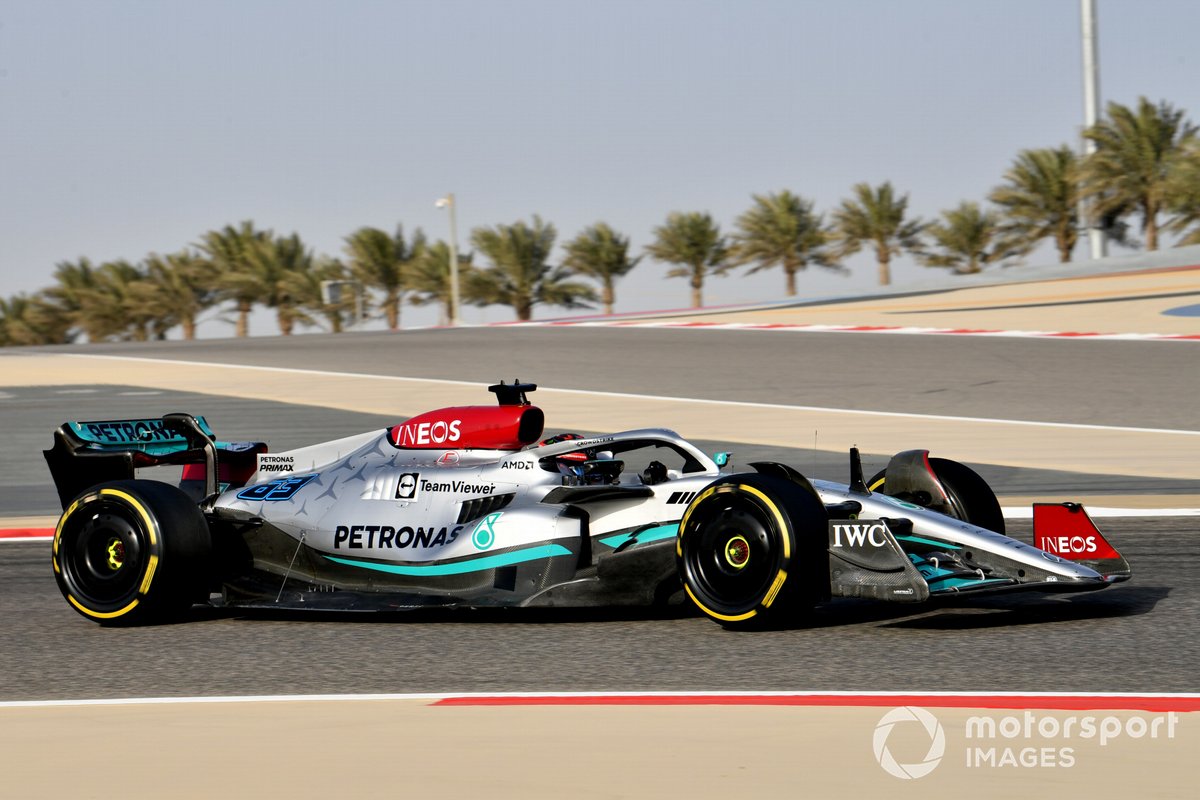
George Russell, Mercedes W13
Photo by: Mark Sutton / Motorsport Images
"For example the intercooler, is a very, very neat device. It's a water/air intercooler, which of course Mercedes have had for a little while, but I think this is a little bit different.
"And that's why they can really shrink wrap this car a little bit more than most of the others can."
Expanding on what Mercedes had done, he added: "The intercooler that I was talking about comes from Reaction Engines in Oxfordshire, the people who are doing this sort of air-breathing rocket motor, and the sort of spin-off from that has been this really extremely efficient heat exchanger technology.
"I think that's part of the reason why they've been able to produce the car the way they have."
Symonds stressed that all teams have honed their packaging to make sidepods as small as possible.
"One of the trends we're seeing, and it's not particular to these new regulations, but we're seeing that it's very, very difficult to start to package everything into the sidepods," he said.
"People think what's in the sidepods, surely it's only the radiators, the heat exchangers?
"But of course, there's a lot more, there's a lot of electronics in there. I think some people are moving that electronics into that keel area."

Mercedes W13 side detail
Photo by: Giorgio Piola
The sidepods and cooling concept aside, Symonds suggested that nothing else on the W13 had caught his eye.
"I think the rest of it looks, dare I say, reasonably conventional - if there's such a thing as conventional," he said.
"The front wing treatment, very much what we expected to see.
"Rear wing yes, a little bit of change in camber in that again, which a lot of people have adopted for this very, very clear sort of path to the lower rear wing, the sort of beam wing at the back, which a lot of people are trying to do now."
Share Or Save This Story


Krack: Aston Martin F1 team no longer in “no-man’s land”

Gasly rues costly floor damage from Ocon contact in F1 Japanese GP

How an F1 underachiever became a Japanese political player


How can Antonelli become F1 world champion at US GP?

Russell bemoans "very bad" Saturday at Singapore GP

How the Bahrain GP in Malaysia exposed Red Bull’s hidden resurgence

DTM Hockenheim: Engel wins race 2 as Preining secures championship

Verstappen jokes about coded messages as Red Bull phases in Lambiase’s successor

BTCC Brands Hatch: Cammish handed victory after Collard penalty

Why Verstappen's dominance left rivals scrabbling for alternatives in Singapore
Subscribe and access Autosport.com with your ad-blocker.
From Formula 1 to MotoGP we report straight from the paddock because we love our sport, just like you. In order to keep delivering our expert journalism, our website uses advertising. Still, we want to give you the opportunity to enjoy an ad-free and tracker-free website and to continue using your adblocker.


Top Comments